Platform Framing vs Balloon Framing: A Guide for Toronto & GTA Homeowners
If you are planning a new home, an addition, or a structural renovation in the Greater Toronto Area, the framing method used will affect code compliance, fire safety, energy performance, and your total project cost. In 2026, with Ontario Building Code (OBC) Tier 3 energy efficiency standards in effect across much of the GTA, framing decisions carry more weight than ever.
This guide explains what platform framing and balloon framing are, how they compare structurally and practically, and what each method means for homeowners and builders working in Toronto and the surrounding municipalities.
What Is Platform Framing?
Platform framing is the standard wood-frame construction method used in virtually all new residential builds across Canada. Each floor level is framed independently, with wall studs running from that floor to the ceiling of the same story. A structural subfloor, or platform, is installed before the walls of the next story are erected.
This method became dominant in North America through the 1950s as standardized dimensional lumber production made it practical at scale. The Ontario Building Code (Regulation 332/12) treats it as the default for new wood-frame construction because each floor platform acts as a natural fire stop between levels, satisfying fire-safety requirements without any additional retrofit work.
For a Custom Home Framing project in Toronto or the GTA, platform framing is the starting point for virtually every structural layout, from a modest urban infill to a large-lot luxury build.
How Platform Framing Works?
Each story is constructed in sequence. The crew frames the floor system and sheathes it to form the platform, then erects the wall framing for that level on top of it. The sequence repeats floor by floor. Structural loads are transferred through each floor platform before reaching the story below.
The basement framing stage is where platform construction begins. Walls are framed on the foundation slab or off the foundation wall, and the first-floor platform is built on top before any above-grade framing starts.
Why Toronto Contractors Use Platform Framing?
Platform framing satisfies the fire-blocking requirements in the Ontario Building Code without any additional retrofitting. Each subfloor inherently blocks the spread of fire and smoke between stories.
It is also faster to build. Crews work on a solid, level platform at every stage, reducing site risk and improving quality control. On tight urban lots in Toronto, North York, or Scarborough, this has real practical value.
Modern insulation assemblies, vapour barriers, and mechanical rough-ins integrate more easily into a platform-framed structure, which matters given the OBC's current energy efficiency tiers.
What Is Balloon Framing?
Balloon framing is an older construction method in which wall studs run continuously from the foundation sill to the roof plate, spanning multiple stories without interruption. Floor joists at intermediate levels are supported by ribbon boards (also called ledger boards) notched directly into the studs.
The method was widely used in North America from roughly the 1860s through the 1930s. In Toronto, much of the pre-war housing stock was built this way, particularly in neighbourhoods developed before 1940.
Balloon Framing Diagram
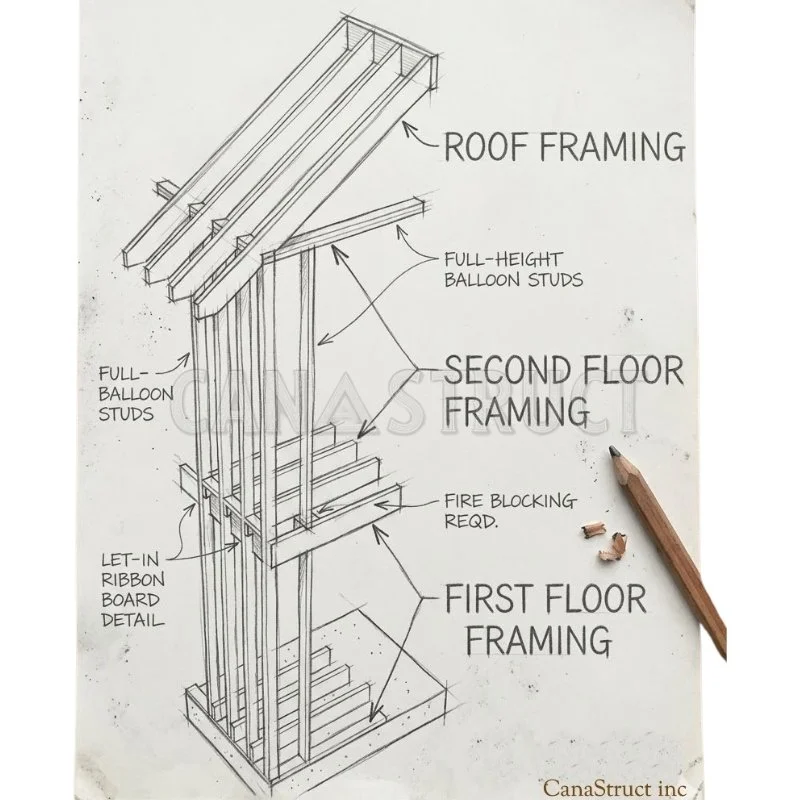
Balloon Framing Diagram
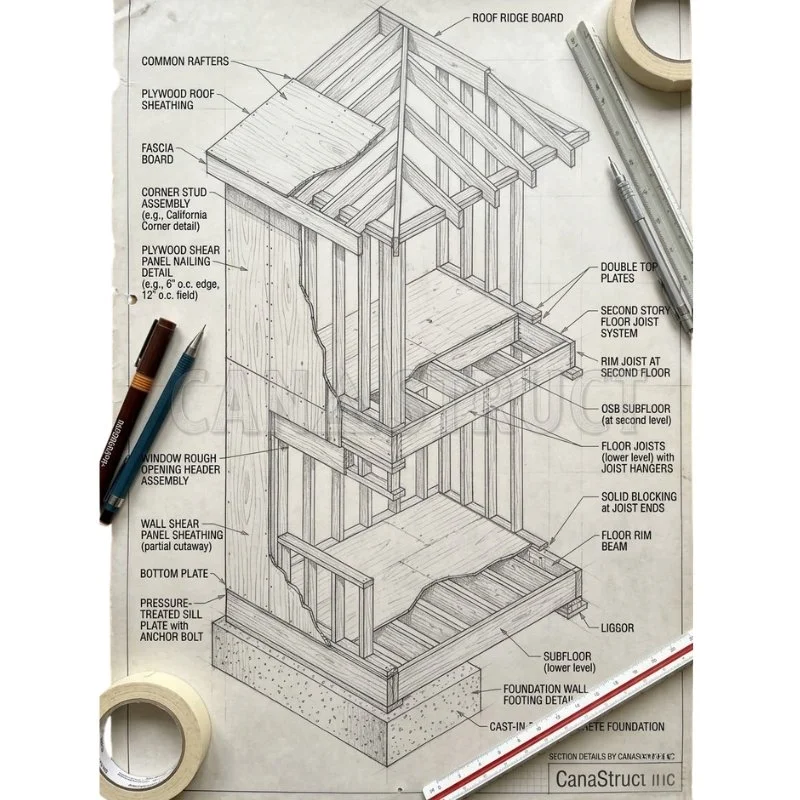
Balloon Framing Diagram 2
Where Balloon Framing Appears in Toronto?
Homes built before 1945 in the following Toronto neighbourhoods frequently have balloon framing:
Riverdale and Leslieville
The Annex and Seaton Village
Parkdale and Roncesvalles
East York and Danforth Village
High Park and Bloor West Village
If your home dates to this era, a structural inspection of the wall cavities, the basement rim joist area, or the attic access framing can confirm whether continuous studs are present.
How Balloon Framing Works?
Because the studs bypass the floor levels, there is no horizontal member creating a fire stop between the basement, first floor, second floor, and attic. In a fire, the wall cavities act as vertical flues, accelerating flame and smoke movement through the entire structure.
Floor joists do not rest on a rim joist or platform assembly. Instead, they sit in notched ledger boards fastened into the studs. This creates a different structural load path than platform framing and complicates modifications to the building's layout.
Balloon Framing vs Platform Framing: Key Differences
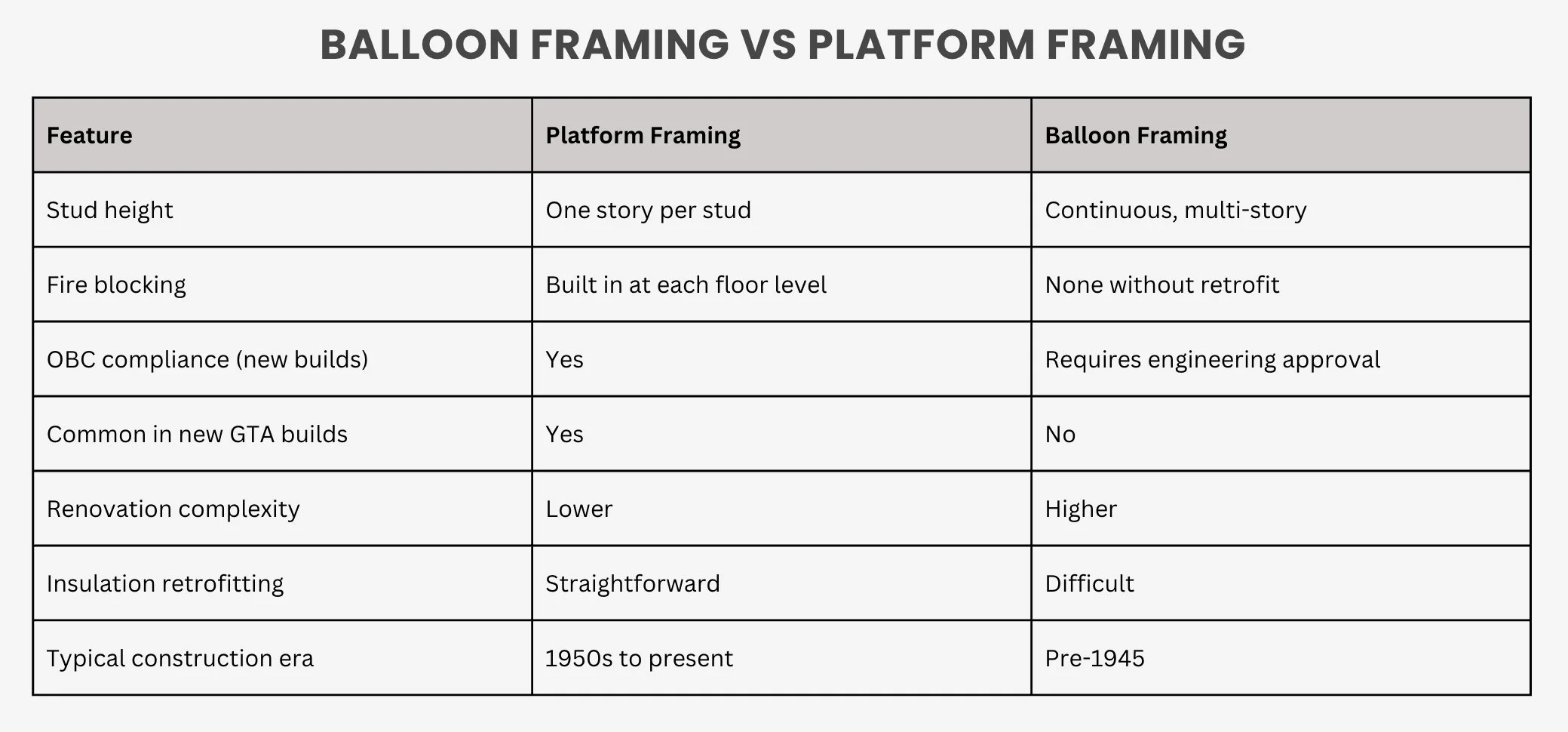
Advantages of Balloon Framing
Despite being largely obsolete for new construction, balloon framing has genuine structural advantages that are worth understanding, particularly if you own an older Toronto home or are working on a heritage restoration.
Reduced shrinkage in tall walls
Because the studs span the full height without splices at each floor level, there is less wood drying across horizontal joints. In multi-story homes, exterior cladding and interior finishes over tall walls experience less vertical movement over time. Platform-framed buildings can exhibit minor settlement at each floor platform as lumber dries.
Strong vertical load paths
Continuous studs transfer roof and wall loads directly to the foundation without the horizontal interruptions that occur at each floor platform in conventional framing. This is part of why many pre-war Toronto homes remain structurally sound more than a century after construction.
Easier framing for tall openings
The uninterrupted stud height allows for tall window and door openings without stacking separate cripple walls between floor levels. This has practical relevance in heritage renovation work where original window proportions need to be preserved.
These advantages do not outweigh the fire safety and insulation deficiencies for new construction, and the Ontario Building Code reflects that. But they matter when evaluating an older property or planning a sympathetic heritage renovation.
GTA Framing Costs by Region (2026 Estimates)
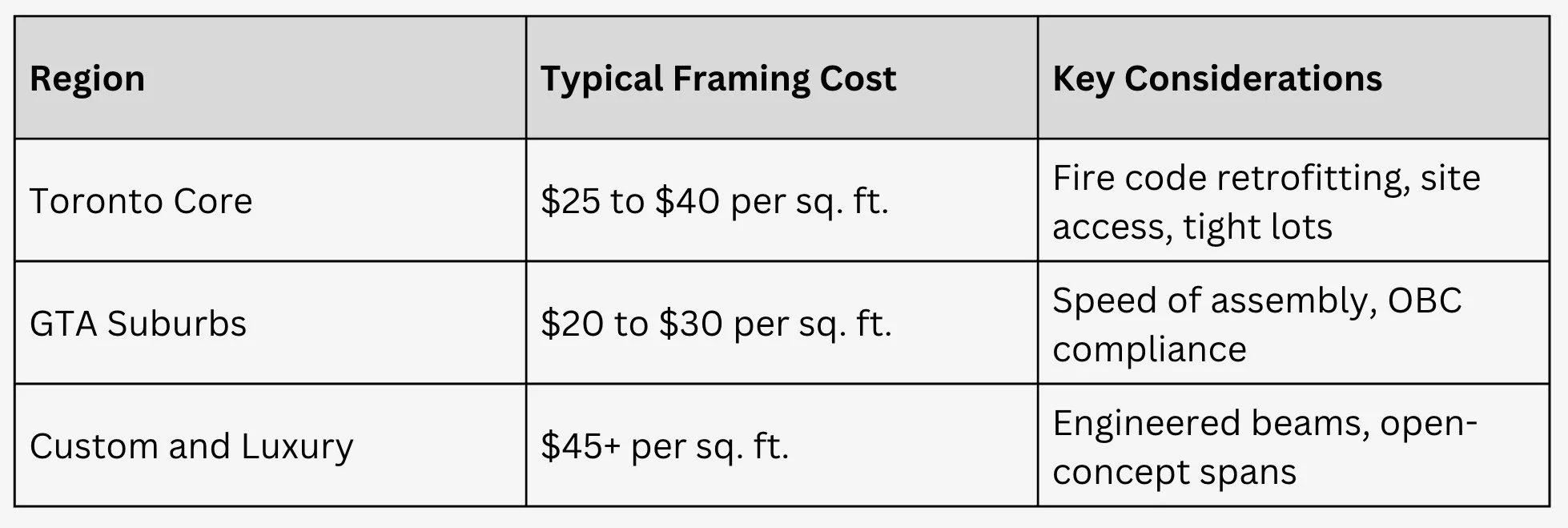
These are estimates for wood-frame residential construction including lumber. Steel framing carries different cost structures. See our metal stud framing contractor page for commercial and hybrid-frame pricing.
Framing Considerations Across GTA Municipalities
Toronto and East York
Pre-war neighbourhoods require fire-stopping upgrades during any renovation that opens wall cavities. The City of Toronto's building inspectors routinely flag this on permit inspections for older homes.
Vaughan and Richmond Hill
These municipalities are active markets for high-end custom builds. OBC Tier 3 energy compliance is the standard, and platform framing is the only practical way to meet it. Engineered wood products (EWP) are commonly used for long spans.
Mississauga and Brampton
The 2026 Development Charge relief in Peel Region has increased garden suite and addition activity. Platform framing gets these projects through the permit stage faster.
Oakville and Burlington
Lakefront proximity and higher wind loads make engineered framing assemblies common. Tall-wall framing in custom homes regularly requires a structural engineer's sign-off, particularly where lateral wind loads must be managed.
In roof framing across the GTA, seasonal wood movement can cause truss uplift, a condition where roof trusses bow upward in winter due to differential moisture content between the top and bottom chords. Platform-framed structures with properly detailed ceiling connections are less vulnerable, but it is worth discussing with your framing contractor during design.
When Framing Involves More Than the Walls
Framing decisions ripple through the rest of a project. A few areas that benefit from early planning:
Load-bearing wall identification: When modifying an existing structure, confirming which walls carry structural loads before any framing work begins is essential. See our load bearing wall page for more details. Misidentifying a structural wall is one of the most costly errors in residential renovation, particularly in balloon-framed homes where load paths differ from conventional platform construction.
Back framing in commercial and multi-unit work: In commercial renovation and multi-unit residential projects, back framing is often required to bring existing structural assemblies up to current code or to create new attachment points for cladding, mechanical systems, or interior partitions.
Drywall and finishing: Once framing is complete and inspected, drywall installation follows. Framing quality directly affects how well drywall lays flat, how corner beads align, and whether finished walls require remedial shimming. Precision at the framing stage reduces finishing costs.
Renovating a Balloon-Framed Home in Toronto
If you own a pre-1945 Toronto home and are planning a renovation that involves opening walls, you should expect the following:
Fire stopping is almost always required
The City of Toronto and surrounding municipalities typically require horizontal fire blocking to be installed in wall cavities at each floor level when those cavities are exposed during renovation. This is generally a condition of permit approval, not an optional upgrade.
Insulation presents challenges
The continuous wall cavities in balloon framing make retroactive insulation difficult. Standard batt insulation cannot be installed without opening the walls fully. Blown-in insulation through drilled access points is an option but requires careful detailing to avoid gaps around the ledger boards.
Structural modifications need engineering
If you are removing or altering a load bearing wall in a balloon-framed structure, a structural engineer's drawings are required before work begins. The load paths differ from platform-framed homes, and assumptions based on conventional framing can lead to unsafe conditions. The combination of fire stopping, insulation upgrades, and engineering fees is why balloon-framed renovations typically cost more than equivalent work in platform-framed homes.
Frequently Asked Questions
When was platform framing invented?
Platform framing developed gradually in North America, with its roots in the mid-20th century. It began replacing balloon framing broadly through the 1940s and 1950s as standardized dimensional lumber production made the method practical at scale. By the 1960s, it had become the dominant residential framing method in Canada and the United States, where it remains the standard today.
Is balloon framing better than post and beam?
They are different systems suited to different purposes. Post and beam construction uses large timber members with traditional joinery, offering wide open spans and long-term durability. Balloon framing uses lighter dimensional lumber and was designed for faster, more economical production construction. Post and beam generally outperforms balloon framing in open-plan design flexibility and structural longevity. For new construction in Toronto, neither is the standard method, as platform framing with engineered lumber is what the Ontario Building Code and modern practice call for.
What is the major problem with balloon frame construction?
Fire safety is the defining issue. In a balloon-framed structure, wall cavities run unobstructed from the basement to the roof. In a fire, these cavities function as vertical flues, drawing flames and hot gases upward and spreading fire to every floor level rapidly. The National Building Code of Canada and the Ontario Building Code both require fire blocking at each floor level in wood-frame construction for this reason. Balloon framing, by definition, does not provide this blocking without a retrofit.
How do I tell if my house is balloon-framed?
The most reliable indicator is the age of the home. Houses built before 1940 in Toronto have a high probability of balloon framing. To confirm, examine the basement wall framing. In a balloon-framed home, floor joists at the first-floor level rest in notched ledger boards cut into the studs, rather than sitting on a rim joist above the foundation. The studs continue past this point rather than stopping at the floor level. Checking the attic access framing for studs that appear to run the full wall height is another indicator. A professional framing contractor can confirm this during a site visit.
Working with a GTA Framing Contractor
Both platform and balloon framing decisions have downstream consequences for fire safety, structural performance, energy efficiency, and project cost. In Toronto, where pre-war housing stock is dense and permit requirements are detailed, working with a contractor who understands both systems reduces the risk of surprises during inspection.
CanaStruct works across the GTA on new builds, additions, renovations, and commercial projects. Whether you are starting fresh with Custom Home Framing or retrofitting a balloon-framed structure to meet current code, we handle the structural work from basement to roof.
Contact us at (647) 641-0550 or build@canastruct.ca to discuss your project.
External links referenced in content:
Ontario Building Code (Reg. 332/12): https://www.ontario.ca/laws/regulation/120332
National Building Code of Canada: https://nrc.canada.ca/en/certifications-evaluations-standards/codes-canada
CMHC Housing Research: https://www.cmhc-schl.gc.ca