As-of-Right Fourplex Rules in Toronto
4 units As-of-right on almost every residential lot in Toronto
0 rezoning No Committee of Adjustment needed for a compliant design
30%+ More framing complexity vs. a single-family build
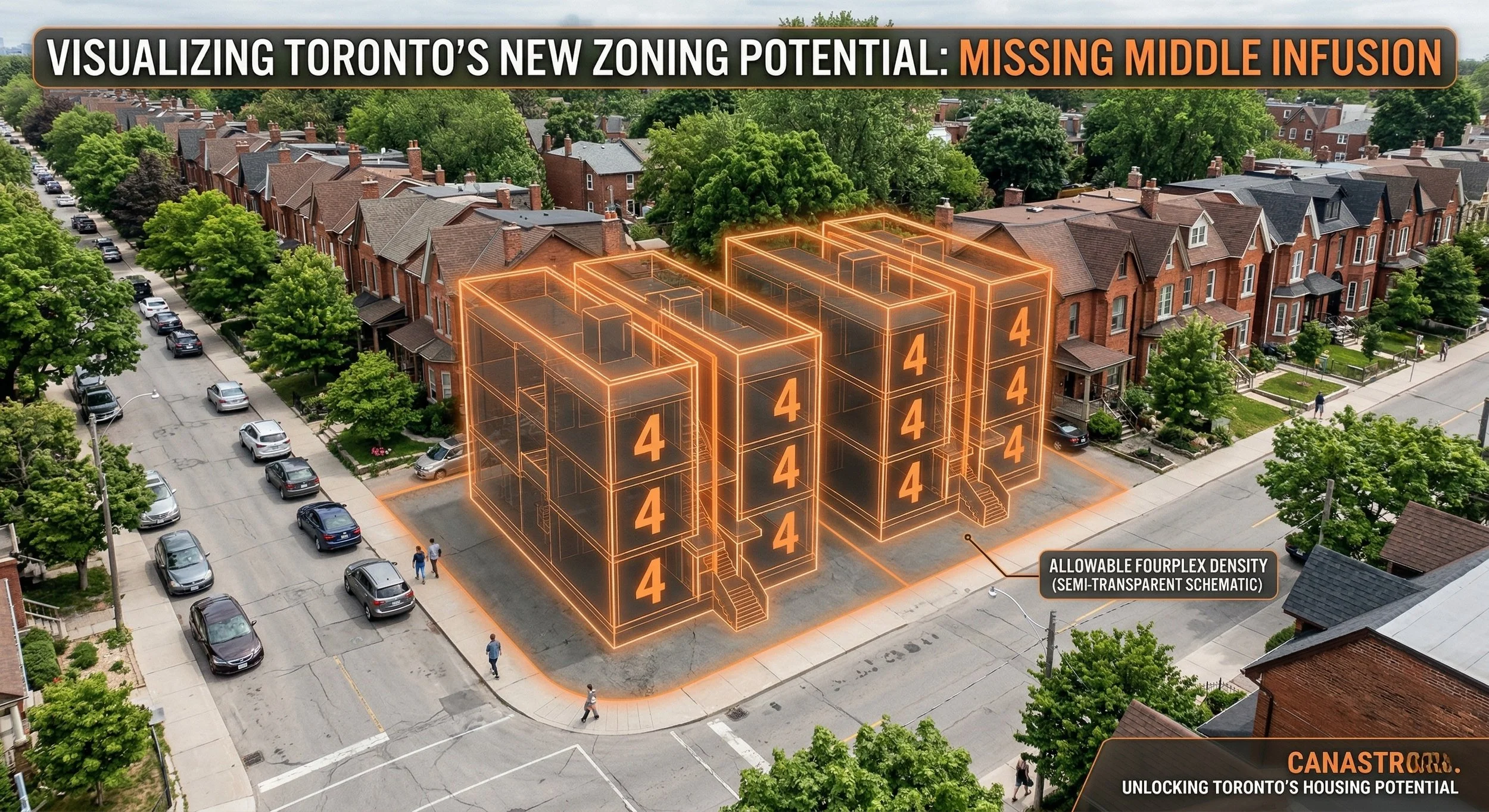
The zoning change that Toronto builders have been waiting years for is here — and it's real. As of May 2023, fourplexes are permitted as-of-right on almost every residential lot in the city. No rezoning application. No Committee of Adjustment hearing. No six-to-twelve month approval process. Just a building permit, a compliant design, and a framing crew that knows what they're doing.
That last part is where most of the conversation goes quiet. Everyone's talking about the zoning. Fewer people are talking about what a fourplex frame actually requires — and where it departs, meaningfully, from a single-family build.
We've been framing multiplexes in the GTA for years. Here's our straight read on what the policy change means in practice, and what changes the moment you decide to build four units instead of one.
What Bill 23 and Toronto's EHON Changes Actually Did
Bill 23 — the More Homes Built Faster Act was Ontario's 2022 provincial push to force municipalities to allow more density. One of its key requirements: cities couldn't block "additional residential units" on properties where a house already existed. But the more significant local action for Toronto specifically was the City's own EHON (Expanding Housing Options in Neighbourhoods) initiative, which moved faster and went further.
In May 2023, Toronto City Council adopted sweeping amendments to its Official Plan and Zoning By-law that permit multiplexes — up to four self-contained dwelling units across essentially all Neighbourhood-designated residential lots citywide. This is the most significant residential zoning change Toronto has made in decades.
How the policy evolved
Bill 23 passed (Province of Ontario) (2022)
Municipalities required to permit additional residential units. Development charges eliminated for up to 3 units. Foundation of what followed.
Toronto adopts as-of-right fourplex permissions citywide (2023)
Duplexes, triplexes, and fourplexes now permitted on all Neighbourhood-designated residential lots — no rezoning, no variance for a compliant design.
Ontario Regulation 462/24 in force (2024)
Further relaxes performance standards for additional residential units — lot coverage increased to 45–60%, FSI limits removed, angular plane restrictions eased.
Development charges fully waived for up to 4 units (2025)
Saving $200,000–$270,000 per fourplex project compared to pre-reform costs. Sixplex permissions added in Toronto & East York district and Scarborough North (Ward 23).
The short version: On most Toronto residential lots, you can now apply directly for a building permit for a fourplex. No rezoning hearing, no Committee of Adjustment, no waiting for Council. If your design meets the zoning standards — height, setbacks, lot coverage, parking — it goes straight to permit review.
The Key Zoning Rules You Still Have to Meet
As-of-right doesn't mean anything goes. It means you don't need a rezoning — but your design still has to satisfy the numerical zoning standards. These are the ones that shape the framing envelope most directly.
10 mmax height (3 storeys)
19 mmax building length
45–60%max lot coverage (Reg 462/24)
3max bedrooms per unit average
0required parking spaces
The bedroom cap is worth flagging — the OBC and city rules effectively limit fourplexes to an average of 3 bedrooms per unit, meaning a maximum of 12 bedrooms across the four units. You can distribute them unevenly (one 4-bedroom unit is fine if another is 2), but you can't build four 4-bedroom units and call it a fourplex. This is a design constraint that needs to be resolved with your architect before framing drawings go anywhere near a permit application.
The parking waiver is one of the most significant financial changes. Previously, on-site parking requirements could add $25,000–$50,000 in excavation and construction costs per space. That cost is now gone for multiplexes up to four units — no minimum parking required at all. The framing implication: no garage, no ramp, less structural complexity at grade.
The Development Charge Story and Why It Changes the Math
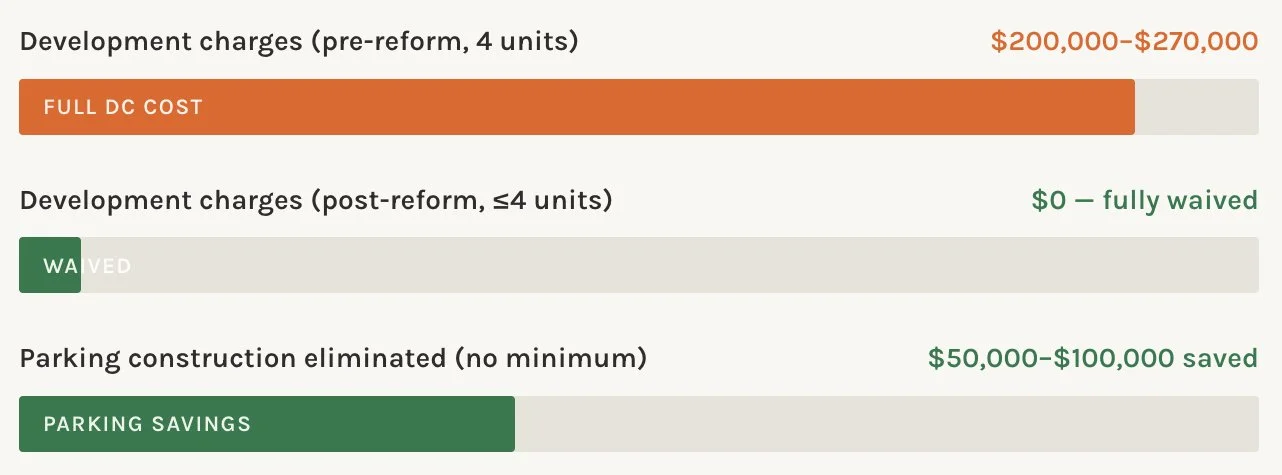
Before these reforms, development charges on a new residential building in Toronto were a project-killer for small multiplexes. By the time you paid DCs on four units, you could be looking at $200,000–$270,000 in charges before you'd driven a single screw. Under Bill 185, those charges are now fully waived for fourplexes.
Development charge impact — fourplex in Toronto (approximate, pre- vs. post-reform)
Zoning Rules
The combined effect, zero DCs, no parking requirement, can shift the feasibility of a fourplex project by $250,000–$370,000. That's the policy change that's actually moving projects from concept to permit applications.
What Actually Changes in the Frame (From Our Side of the Jobsite)
Here's where most of the policy conversation stops and our part of the conversation begins. A fourplex isn't a single-family home with three extra kitchens. The framing is structurally and code-wise a different animal — and if the framing crew doesn't know that going in, the project will reflect it.
These are the framing differences that matter.
Fire Separation
This is the one that creates the most problems when a project is conceived without a framer at the table. Fire separation between dwelling units isn't something you add later — it's built into the framing decisions from the ground up, and changing it after walls are up is expensive and messy.
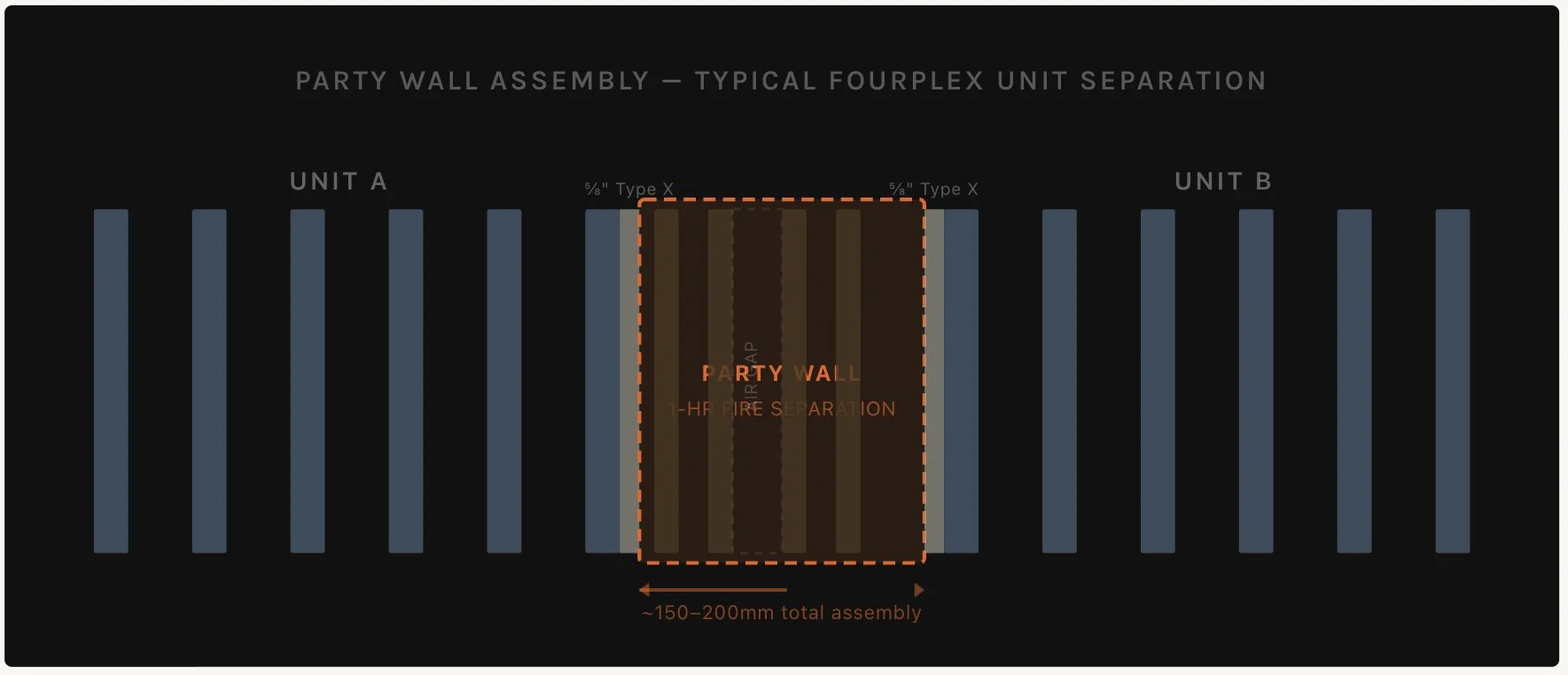
Under the OBC, the floor and wall assemblies separating dwelling units in a 2–4 unit building need to provide a fire-resistance rating. In practice, for a wood-frame fourplex under Part 9, the required separation between units is typically a 1-hour fire-resistance rating on the floor/ceiling assemblies and the party walls.
Fire Separation
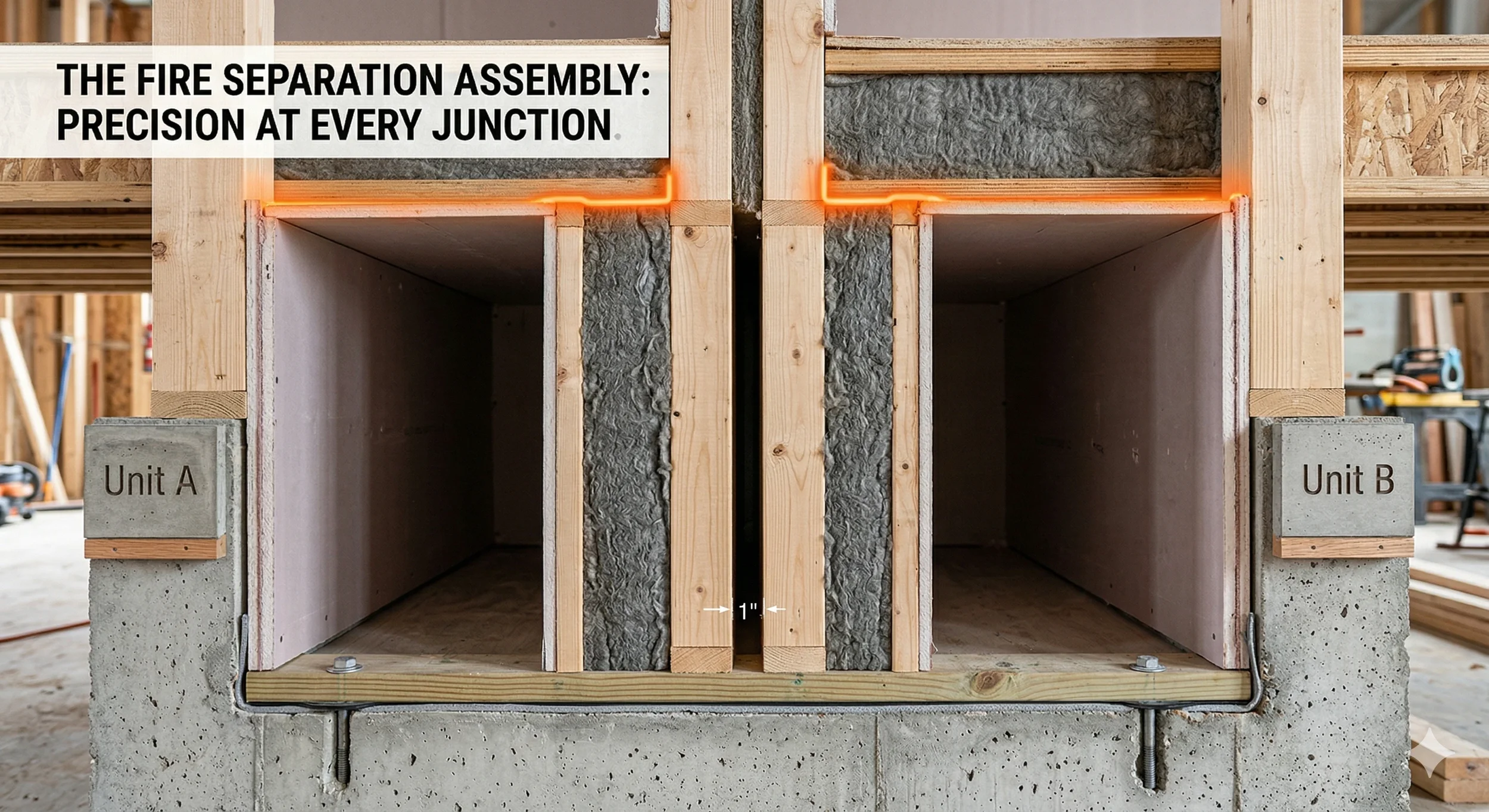
What this means for framing: the party wall between units is typically a double-stud assembly — two independent stud walls with a gap between them — so that the structural load of one unit is not carried by the same framing members that form the other unit's fire separation. If one side were to fail in a fire, it collapses without taking the other wall with it.
This is not the same as a regular interior wall with extra drywall. The framing is different, the sequencing is different, and the location needs to be locked in before the floor system is framed — because the floor assembly above has to maintain the fire-resistance rating at the junction. A framing crew that approaches this the same way they'd frame a partition wall will create problems for every trade that follows.
The detail most framers miss: the fire separation isn't just the wall between units, it's the full assembly, including the floor/ceiling junction where the party wall meets the floor structure above and below. If that junction isn't framed correctly, the fire separation has a gap, and the inspection will find it.
Fire Separation
Egress: Every Unit Needs Its Own Way Out
In a single-family home, egress is relatively simple — you need exits from the floor area, compliant stair dimensions, guards, and that's largely it. In a fourplex, each dwelling unit needs its own means of egress from each floor level it occupies. That requirement shapes the entire plan from the first sketch.
For a stacked fourplex — two units on the ground floor, two on the upper floor — this typically means two separate stair runs, one per pair of units, plus a common exit at grade. For a side-by-side configuration, each unit may share a common interior stair, but those stairs need to be properly framed and enclosed to provide the required fire separation between the stair and adjacent living spaces.
860mm min stair width (clear) — OBC
200mm max riser height
235mm min tread depth (residential)
1,950mm min headroom at any stair
The stair framing decisions where the stair opening is cut, what size, what headroom is available, where the landing falls — need to be made with the finished stair layout already resolved. We've seen projects where the stair opening was framed before the architect finalized the stair calculator, and the rough height didn't land the finished stair within OBC tolerances. The fix is expensive. The prevention is a conversation that happens before the floor system goes down.
Sound Separation
Fire separation is mandatory. Sound separation is partly mandatory and partly a quality-of-life decision but the framing choices that drive one also drive the other.
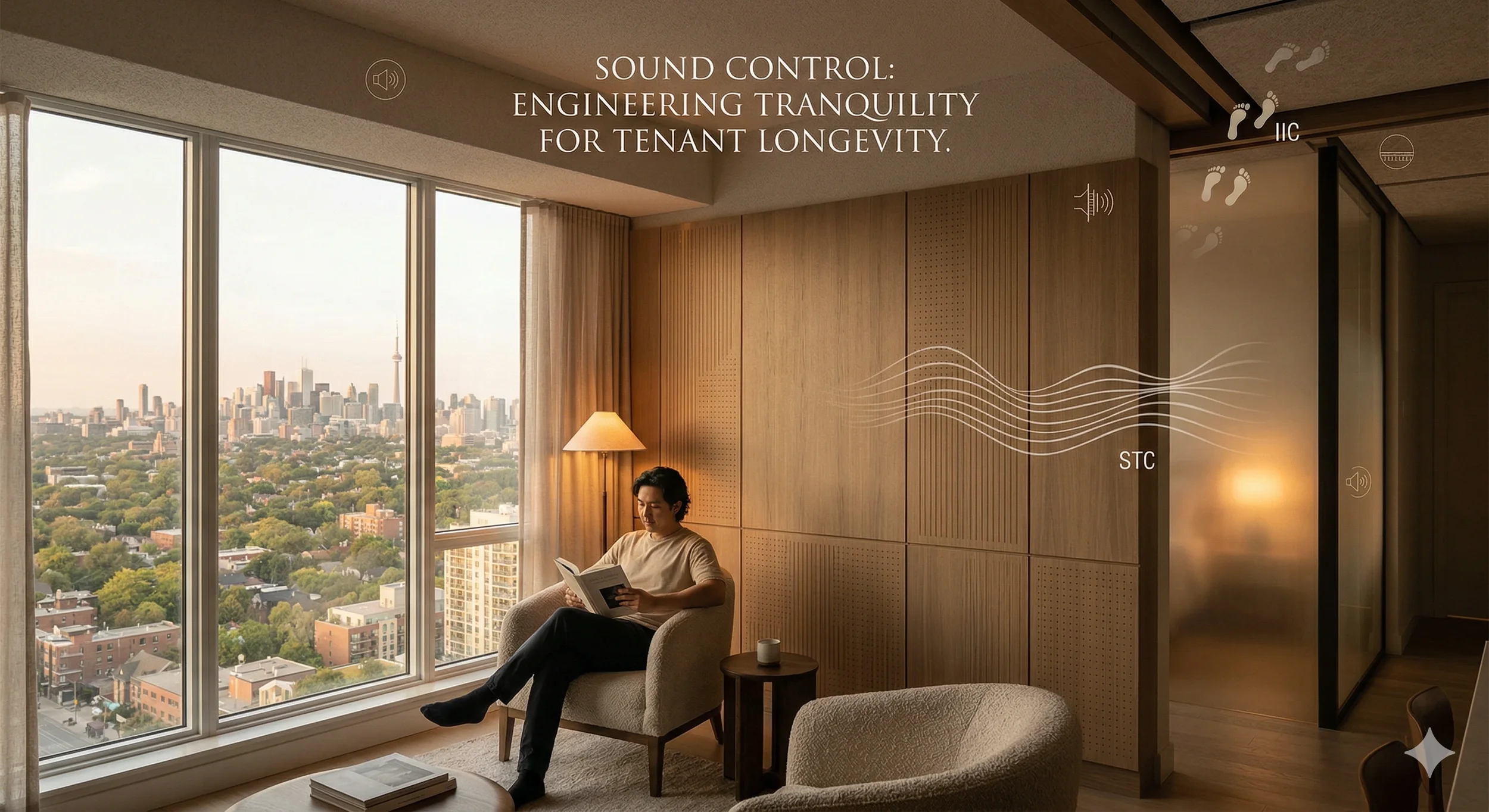
The OBC requires party walls and floor/ceiling assemblies between dwelling units to meet a minimum Sound Transmission Class (STC) rating and Impact Insulation Class (IIC) rating. In practice, meeting the fire rating generally gets you partway there on STC — a properly detailed 1-hour assembly typically achieves STC 50 or better. But floor impact noise (footsteps, dropped objects) is a separate problem that requires specific framing details: resilient channels, floating floor assemblies, acoustic underlayment. None of these are structural in the OBC sense, but all of them affect how the floor system is framed.
A fourplex that's hard to rent is the wrong fourplex
We've seen investors put significant money into a fourplex build, meet code on fire separation, and then discover that sound transmission between units is so poor that tenants don't stay. The framing assembly is where you buy yourself good sound performance — not the drywall, not the flooring finish. By the time the frame is closed in, the opportunity is gone.
Sound Separation
What You Need in Place Before the Frame Starts
A fourplex is a more document-intensive build than a single-family home, and those documents need to be resolved before framing, not during it.
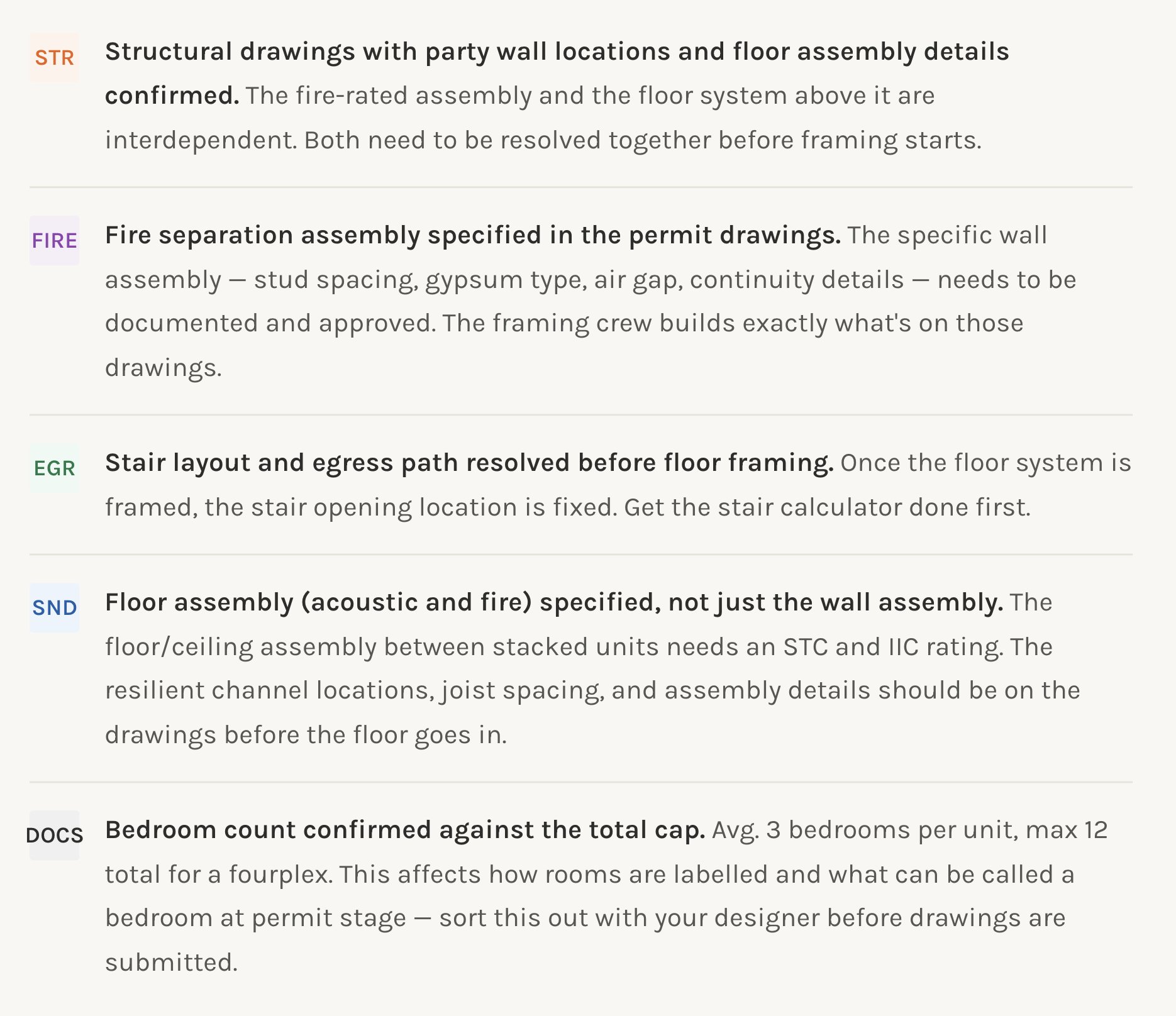
On our projects, we want to see a set of drawings that's been through structural review and has the party wall and floor assembly details called out explicitly before we start framing. Not because we can't problem-solve, we can. But problems solved at the framing stage cost time and money that belongs to you. Problems solved at the design stage cost a red line and an afternoon.
Questions We Get Asked
Can I convert my existing house into a fourplex?
Yes — and it's one of the most common use cases for the new permissions. But conversion is more complex than new construction from a framing standpoint. You need to assess whether the existing structure can support the loads of a reconfigured floor plan, confirm that fire separation can be achieved within the existing framing envelope, and often add structural elements that weren't needed in a single-family configuration.
The short version: a conversion needs a structural engineer's sign-off confirming the existing frame is adequate or specifying what needs to be upgraded. That review should happen before any framing work starts, not after.
Does a fourplex need a sprinkler system in Toronto?
Not automatically. Under OBC Part 9, a three-storey or under fourplex on a single lot generally does not require a sprinkler system as long as fire separation, egress, and alarm requirements are met. However, if the building exceeds 600 m² building area or pushes into Part 3 territory for any reason, sprinkler requirements may be triggered. It's also worth noting that many designers choose to incorporate sprinklers voluntarily — a sprinklered building can sometimes achieve reduced fire-resistance ratings on certain assemblies, which can simplify the framing.
How much more does framing a fourplex cost than a single-family home?
Framing labour for a fourplex typically runs 20–35% higher per square foot than a comparable single-family home, depending on configuration, storey count, and the complexity of the fire separation details. Materials cost more because party wall assemblies use more lumber and require specific gypsum products. The double-stud party wall alone adds meaningful material cost to the assembly.
That said, you're building four units on one lot with no development charges. The per-unit economics of a fourplex are typically significantly better than four separate single-family builds — the framing premium is real but it's not the number that drives the project decision.
Can all four units be stacked, or does the layout affect the framing significantly?
Both stacked and side-by-side configurations work, and the framing implications differ. Stacked — two units below, two above — means the floor/ceiling assembly between the two levels is a required fire separation, and the acoustic details are at the horizontal assembly level. Side-by-side — two units sharing a party wall puts the fire separation at the vertical assembly, and the acoustic issues are at the wall rather than the floor.
Mixed configurations (a basement unit, a ground-floor unit, and two upper units) are common in Toronto infill projects, and each combination creates its own set of fire separation challenges at the junctions. These are worth mapping out with the framing contractor before drawings are finalized.
What about the sixplex permissions? Does that change the analysis?
As of 2025, sixplexes are now as-of-right in the Toronto & East York district (the old City of Toronto and East York) and Ward 23 (Scarborough North). Everywhere else in the former City of Toronto remains capped at four units as of right.
From a framing standpoint, going from four to six units adds complexity — more fire separations, more egress paths, more acoustic assemblies to detail. Sixplexes also lose the ability to add a laneway or garden suite on the same lot. The DC waiver currently applies to fourplexes; for sixplexes, DCs apply on units 5 and 6. The framing analysis for a sixplex is similar in kind to a fourplex, just more of it — and the structural engineering needs to be tighter because the loads are higher and the separation requirements multiply.