Structural Steel vs. Engineered Wood Beams (LVL/LSL): Which Is Right for Your Toronto Build?
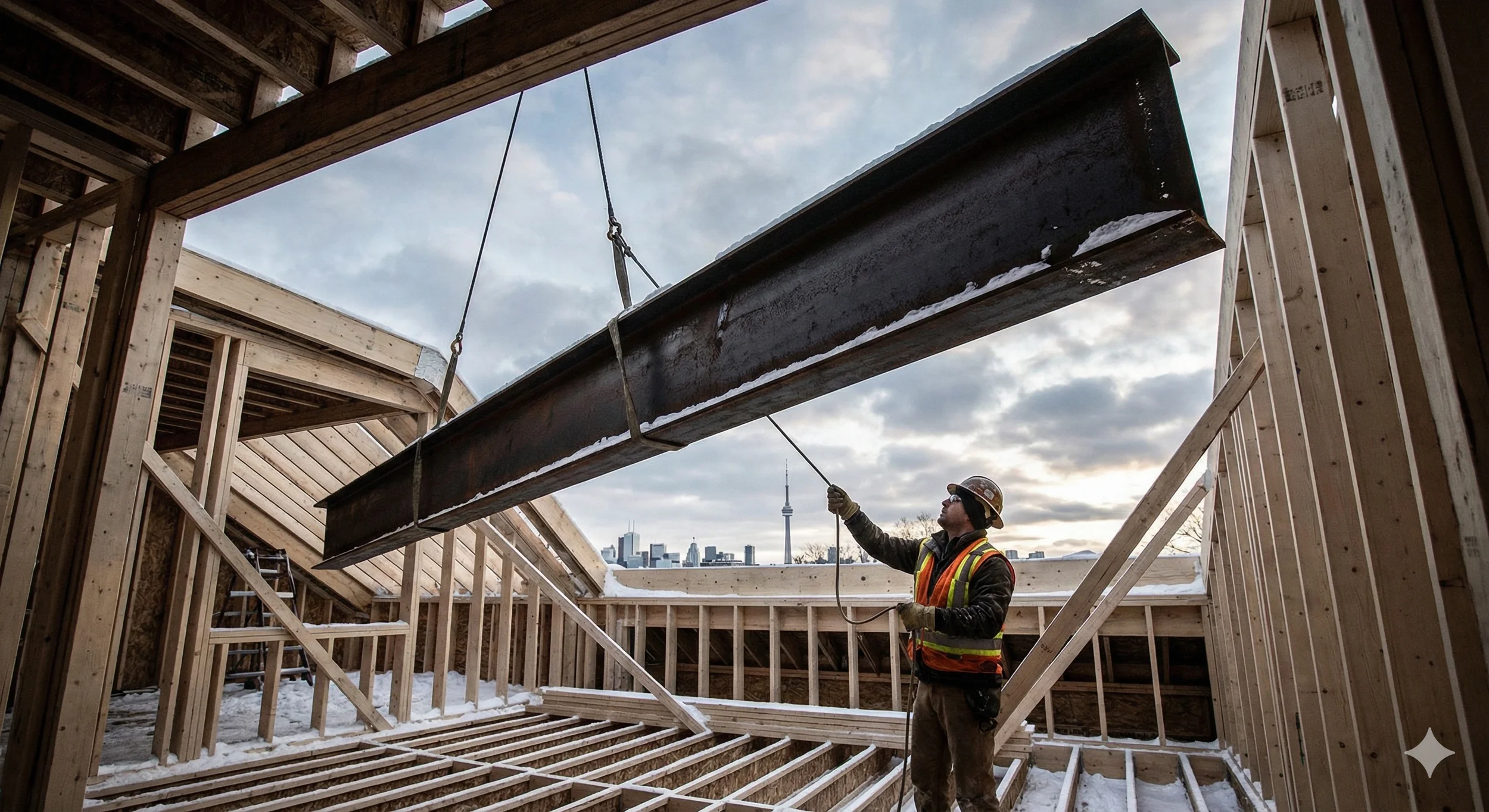
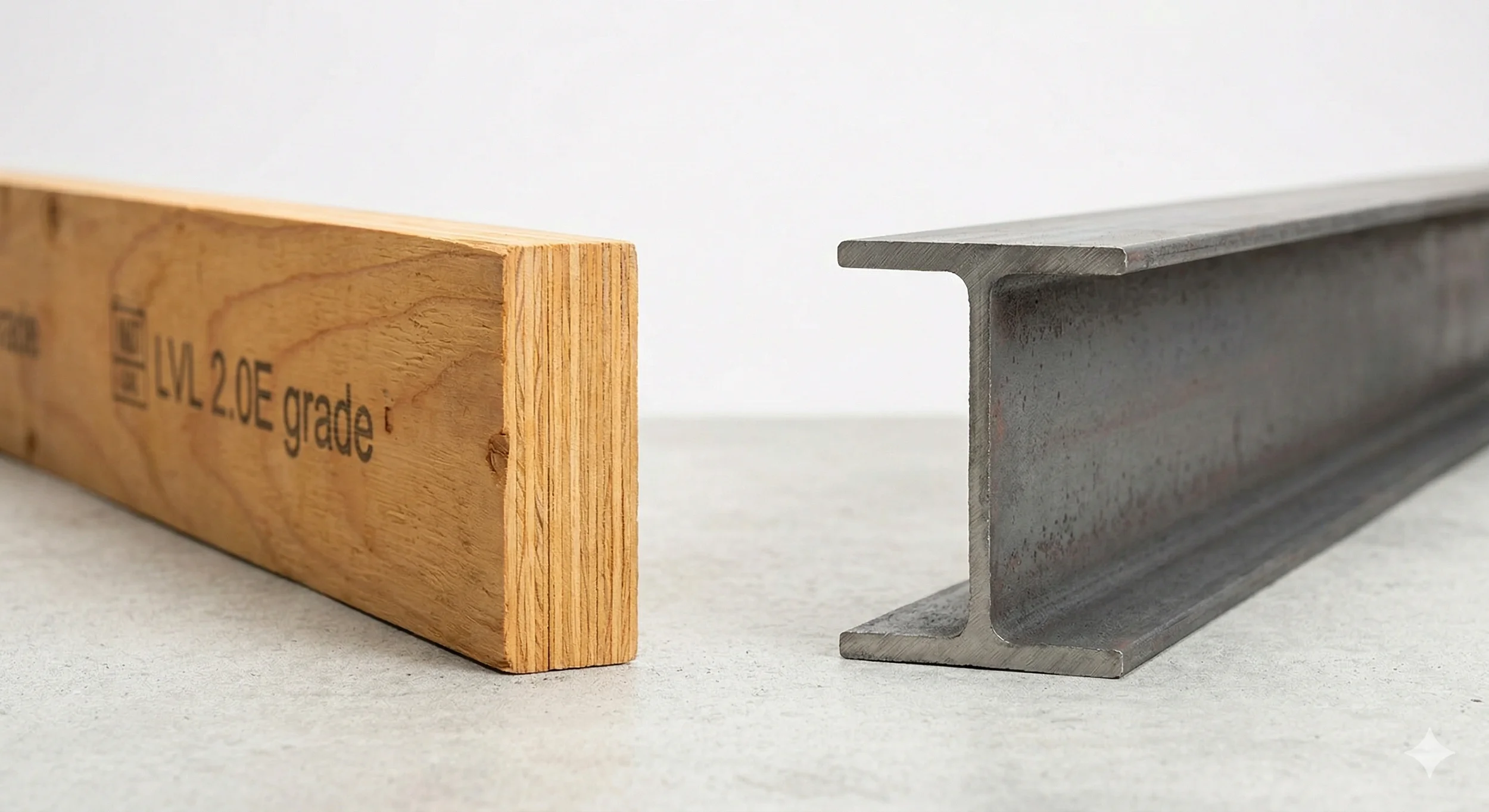
Structural Steel vs. Engineered Wood Beams
The beam question comes up on almost every custom home and multiplex project we frame in the GTA. Your engineer specifies a load requirement. Your architect wants a particular ceiling height. Your budget has a number. And somewhere in the middle of those three things is a choice between structural steel and engineered wood — a decision that ripples through your schedule, your trades list, your crane budget, and your framing sequence.
Neither material wins automatically. They solve different problems, at different costs, with different implications for the rest of the build. Here's the honest version of the comparison, from the people who have to install both.
What We're Actually Comparing
Before cost, it's worth being specific about what each material is — because "engineered wood" covers a range of products that behave quite differently from each other.
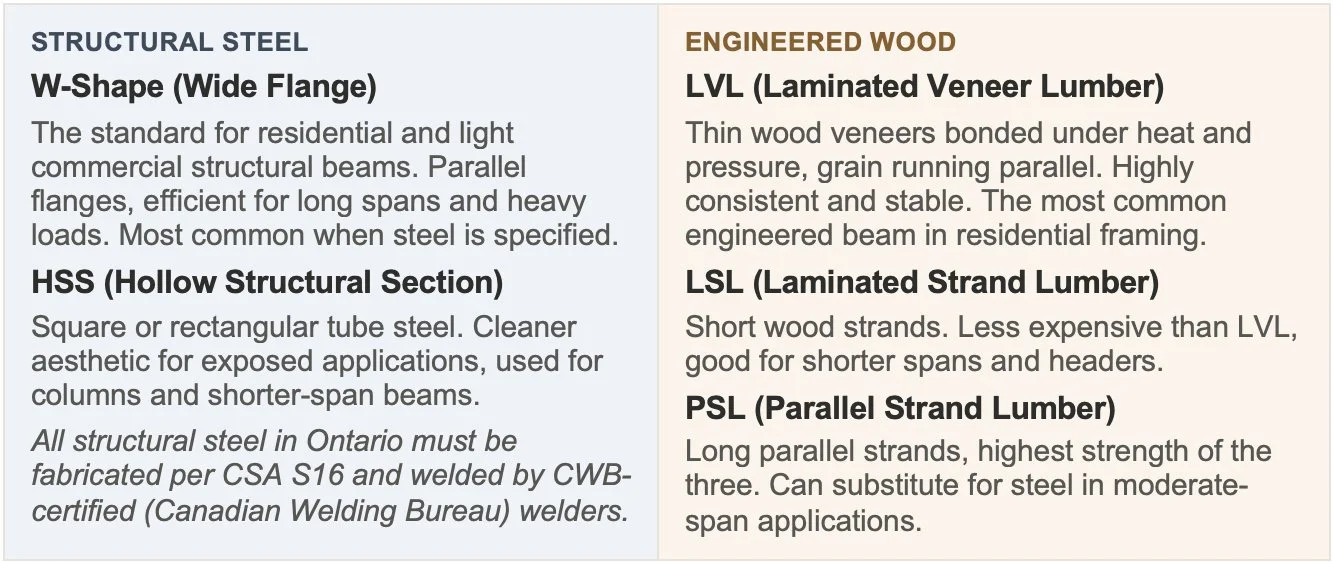
Structural Steel vs. Engineered Wood Beams
Material Cost: Where the Numbers Actually Land
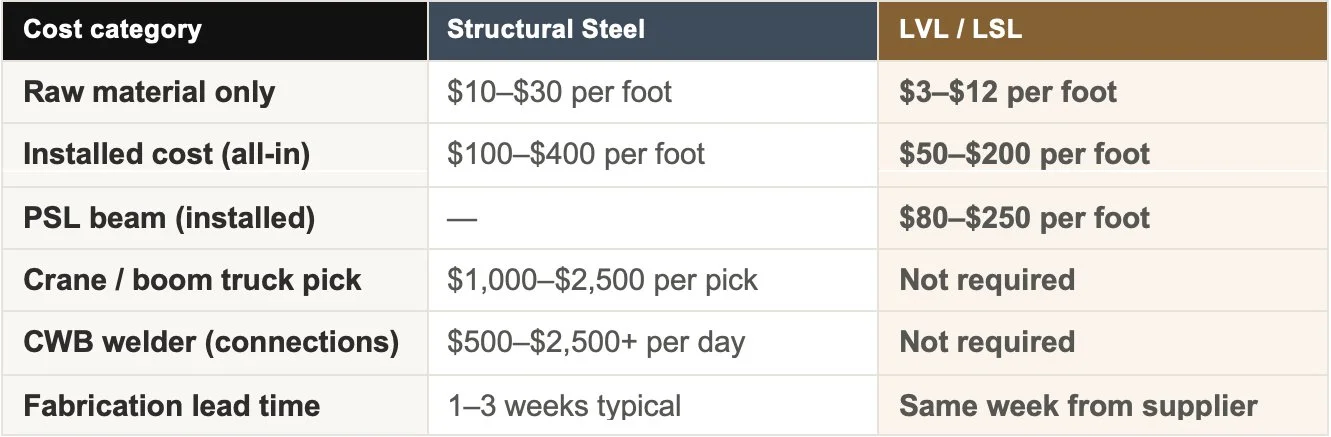
Material cost is where the comparison usually starts — and where people often get tripped up by comparing the wrong numbers. Raw material cost and installed cost are very different conversations, especially for steel.
Material Comparison
The raw steel material cost, typically $10–$30 per foot for a standard W-shape, sounds competitive. The installed cost tells a different story. By the time you've added fabrication, a flat-deck truck to deliver a 6-metre beam, a crane to lift it into position, a CWB-certified welder to make the connections, and primer or fireproofing, that $20/ft beam becomes a $150–$400/ft line item.
Engineered wood doesn't have those layers. An LVL beam gets delivered on a lumber truck, cut by the framing crew with a circular saw, and lifted by hand or with a simple beam jack for most residential spans. The complexity ceiling is much lower.
The number most people miss: a single crane pick for a heavy steel beam on a tight Toronto infill lot — including mobilization, permits if the truck needs to block the street, and operator time — can run $1,000–$2,500 for a half-day booking. That's before any welding.
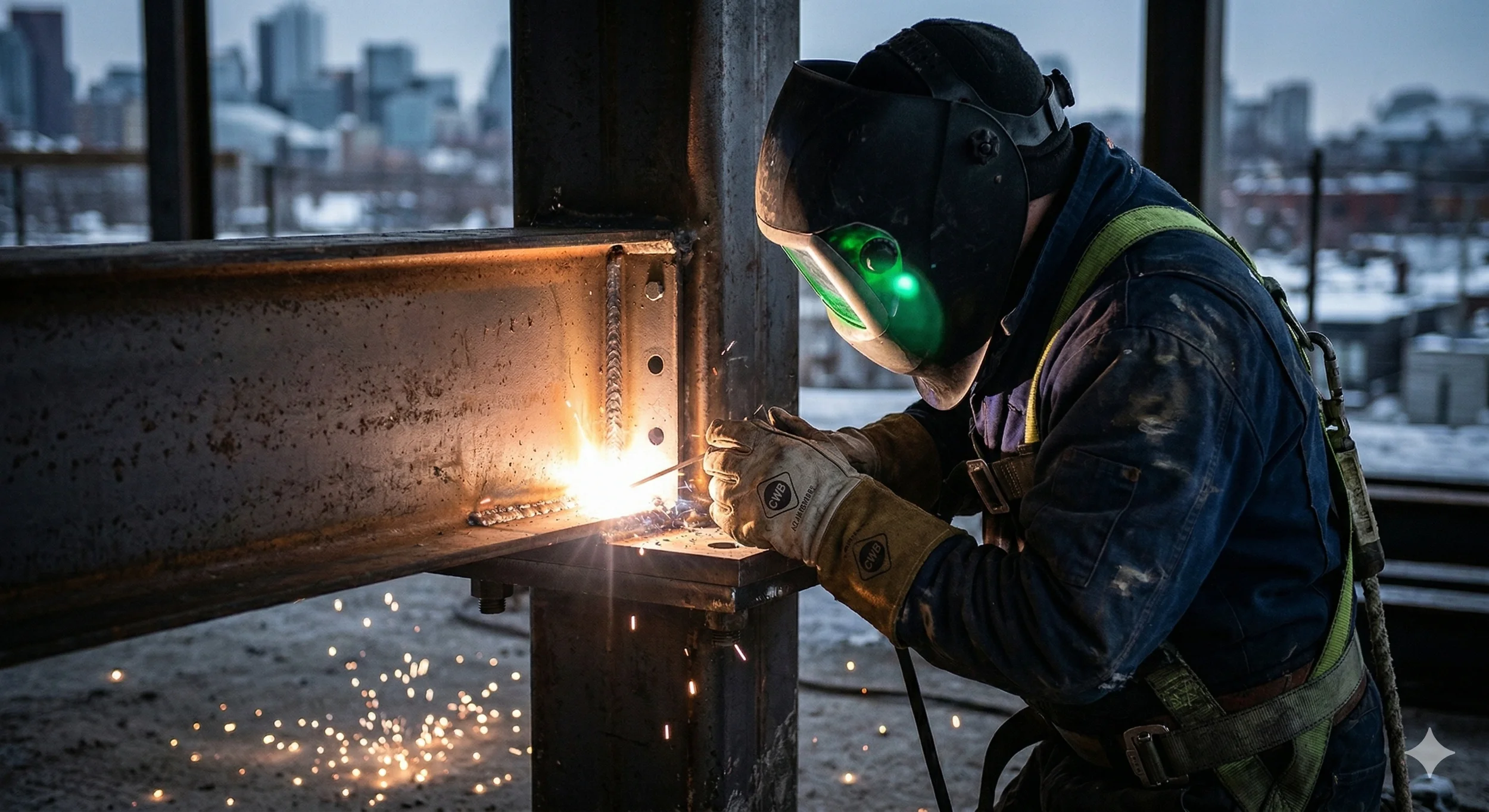
Structural Steel vs. Engineered Wood Beams, Cost Comparison
The Full Steel Cost Picture
Steel is not a material you order and install in one step. Every structural steel beam on a residential or multiplex project involves a chain of costs and trades that don't apply to engineered wood.
1. Structural engineer drawings $500–$2,000+
Steel beam sizing must be engineer-specified. For steel, drawings also include connection details, bearing plate specs, weld requirements, and column sizing — more detail, more engineering time.
2. Fabrication lead time 1–3 weeks, typical
Standard W-sections in Toronto are typically fabricated in 1–3 weeks from finalized drawings. Custom plate work or non-standard sizes take longer. This is a schedule dependency that doesn't exist with LVL, which you can order and receive in 2–5 business days.
3. Delivery — flatbed truck $300–$800 delivery
A 20-foot steel beam weighing 400–700 lbs doesn't arrive in a standard lumber delivery. It requires a flatbed truck, and getting it off the truck and into position on a Toronto infill site often requires equipment. A real logistics challenge in tight urban lots.
4. Crane or boom truck $1,000–$2,500 per pick
For any beam that can't be hand-carried — which is most structural steel beams you need a crane or boom truck. In Toronto, crane rental with operator runs roughly $1,000–$2,500 for a day. Street permits add cost and time if the lane needs to be closed.
5. CWB-certified welder for connections $500–$2,500+ per day
All structural steel connections on OBC-regulated buildings must be made by Canadian Welding Bureau-certified welders — a separate trade from your framing crew. GTA CWB welders typically book at $75–$120/hr plus mobilization. A typical residential steel beam installation takes half a day to a full day of welder time.
7. Fireproofing (if required) Project-specific
Exposed structural steel in a building with a fire-resistance rating requirement needs fireproofing — typically intumescent paint or spray-applied coating. In most Part 9 residential buildings, this isn't triggered for beams buried in assemblies, but for exposed transfer beams in multiplexes, it can be a meaningful additional cost.
Steel's total installed cost is the sum of at least four separate line items that don't exist for LVL.
Fabrication. Delivery. Crane. Welder. Each adds cost, adds schedule dependency, and adds a trade that has to be coordinated. On a project where steel is the right answer, those costs are worth it. On a project where LVL would have worked fine, they're avoidable overhead.
The Engineered Wood Installation Process
The contrast with engineered wood is stark.
1. Engineer specifies size and grade same as steel
LVL and LSL beams still require structural engineering — your engineer specifies the depth, width (e.g., 3-ply 1¾" × 11¼" LVL), and bearing requirements. But connection details are simpler and drawings typically take less time than a full steel connection design.
2. Order and delivery Same week in most cases
LVL and LSL are stocked by GTA lumber suppliers. A standard residential LVL beam can typically be ordered and delivered within 2–5 business days. No fabrication shop, no custom mill order. For standard product sizes, it's a catalogue item.
3. Site cut by framing crew No specialist required
LVL cuts with a circular saw or chainsaw, just like dimensional lumber. Your framing crew handles the cut to length, the notching for bearing, and the connection to adjacent framing. No CWB welder, no separate booking.
4. Lift into position By hand for most residential spans
A 20-foot triple-ply LVL beam typically weighs 200–350 lbs and can be lifted by two or three framers with a beam jack or gin pole. No crane required for most residential applications — one of the biggest practical advantages on tight urban sites.
5. Connections with conventional hardware Included in framing scope
LVL connections use standard structural hardware — beam hangers, post caps, bolts, and structural screws — installed by the framing crew. No separate trade required.
The timeline comparison: A steel beam scenario might add 2–4 weeks of lead time between specification and installation. An LVL beam of equivalent span can typically go from spec to installation in under a week. For projects where the schedule is a hard constraint, that difference matters.
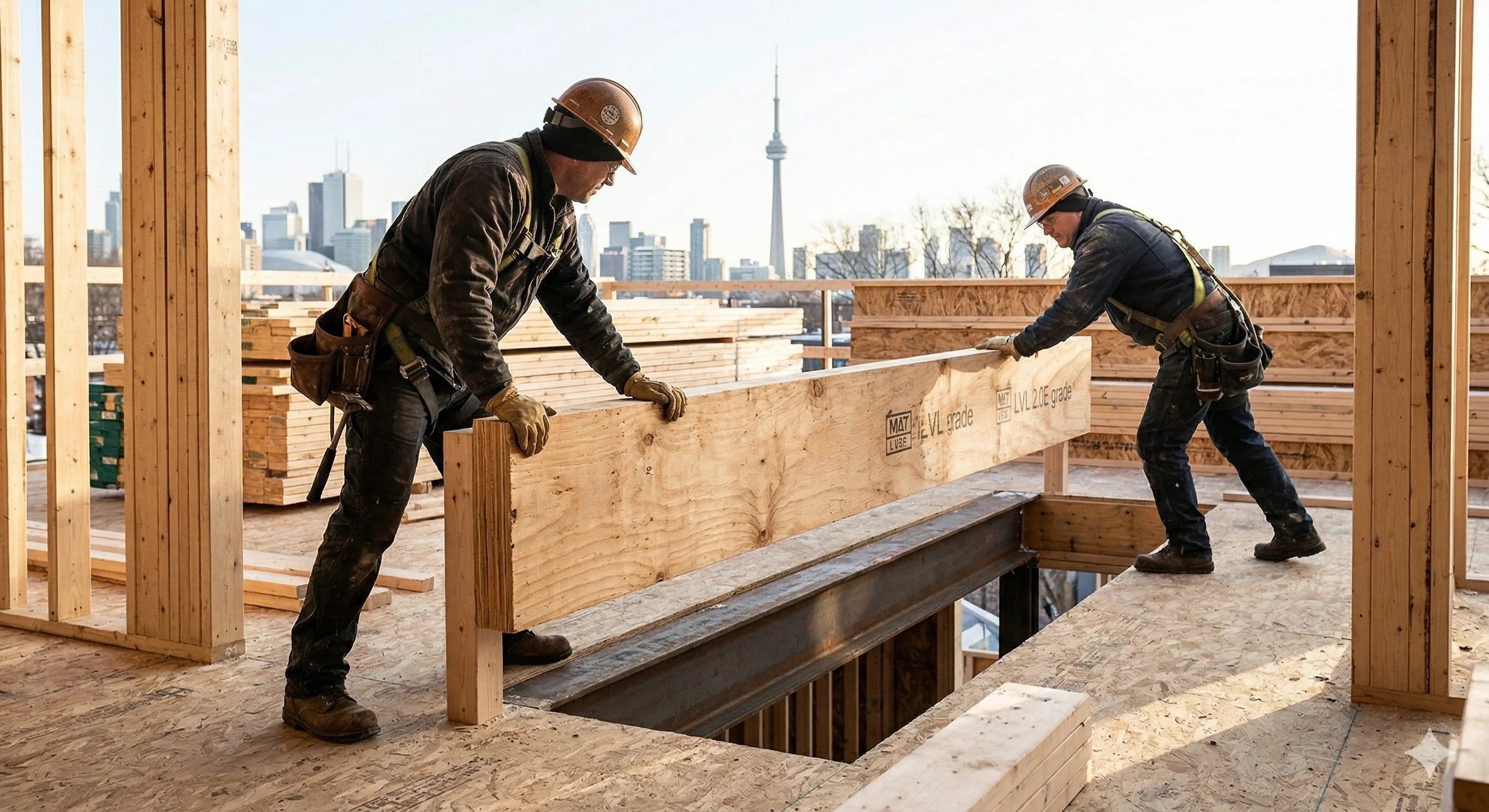
The Engineered Wood Installation Process
Where Each Material Reaches Its Limits
The most important technical distinction is span capability — how far a beam can reach between supports before it deflects beyond acceptable limits or requires a depth that conflicts with the floor system.
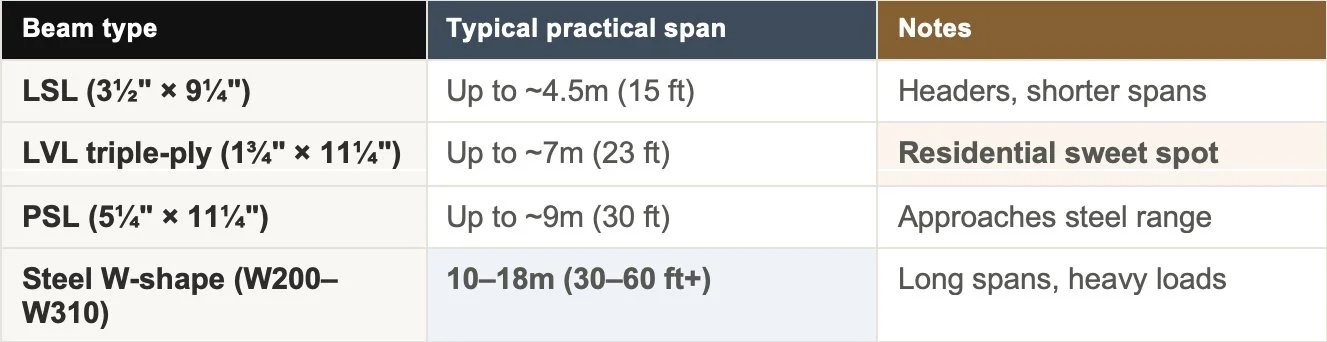
For most custom home scenarios, open-concept main floors, garage spans, and wide doorway headers — LVL handles the load within a reasonable depth profile. The sweet spot is roughly 6–8 metres (20–26 feet). Beyond that, the LVL beam required starts to get very deep, eating into the ceiling height and conflicting with mechanical runs.
Steel's advantage becomes decisive when you need spans over 8–10 metres, when you're carrying very heavy concentrated loads (like supporting a full floor system above an open commercial space), or when the available depth for the beam is constrained, and only steel can achieve the load capacity within a shallow profile.
In multiplex builds, transfer beams, carrying the load of a full wall above an open floor below, are a common reason steel gets specified. A 7-metre transfer beam carrying three floors of load above it is typically going to land in steel territory.
Profile depth matters: A deep LVL beam takes up floor-to-ceiling height. A steel W-shape beam of equivalent capacity can often be shallower — important in basement applications, garage ceilings, or anywhere the mechanical trades need the space above the beam for duct runs.
Head-to-Head: The Full Comparison
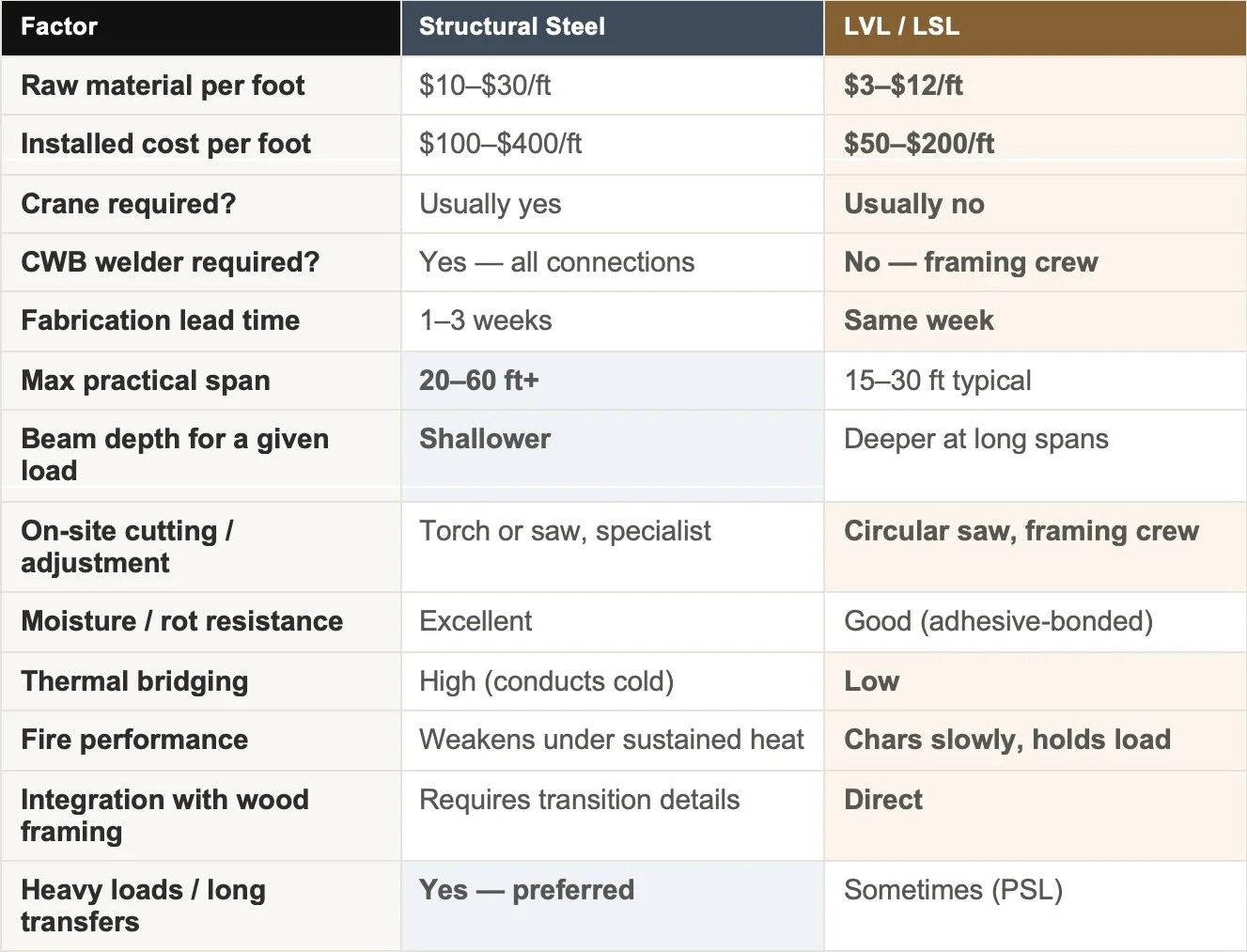
Head to Head: The Full Comparison
One Counterintuitive Point (Fire Performance)
Most people assume steel wins on fire because it doesn't burn. That's technically true but structurally misleading. Structural steel loses significant strength at sustained high temperatures, typically beginning to deform meaningfully above 300–400°C. In a building fire, an unprotected steel beam can fail faster than an equivalently loaded LVL beam of the same load-carrying capacity.
Engineered wood chars on its surface at a predictable rate of roughly 0.6mm per minute for most structural lumber products. That char layer insulates the core, which continues to carry load. Engineers can calculate the residual capacity of a wood beam after a defined fire exposure.
The practical implication: exposed structural steel in a building with a fire-resistance rating requirement needs fireproofing intumescent paint, spray-applied coating, or enclosure in fire-rated materials. That's an additional cost. An exposed LVL or PSL beam in the right application may not require the same treatment.
When Each Material Earns Its Place
We work with both on a regular basis. Here's when each one makes sense.
Use structural steel when
The span exceeds what engineered wood can handle at an acceptable depth. When you need 9+ metres clear, or when the load is heavy enough that an LVL would need to be so deep it conflicts with ceiling height or mechanical runs, steel is the engineering answer.
You're building a transfer beam in a multiplex. Supporting three floors of party walls and floor systems above an open lower level is steel territory. Concentrated loads and span requirements typically push past LVL's practical range.
The beam will be architecturally exposed and you want a slim, industrial aesthetic. An exposed W-shape has a visual quality that engineered wood can't replicate.
You're in a commercial or mixed-use building. Larger spans, heavier live loads, and more demanding fire requirements push the structural solution toward steel earlier.
Use LVL / LSL when
The span is 6–8 metres or under and loads are residential. Opening up a main floor, carrying a floor system over a garage, spanning a large opening — reliable, quick, full installation stays within the framing scope.
Schedule is tight. If you're framing in winter, trying to compress your exposed period, the lead time difference between LVL and waiting for a steel fabrication shop is real and meaningful.
The lot is tight and crane access is difficult. Toronto infill sites — narrow lots, lane access only, trees along the property line — can make crane placement genuinely difficult and expensive. LVL removes that problem entirely for most residential spans.
Budget is a primary constraint and steel's premium is hard to absorb. If the project math is tight and a PSL or LVL solution is structurally valid, there's no reason to take on steel's additional cost chain.
Quick Reference
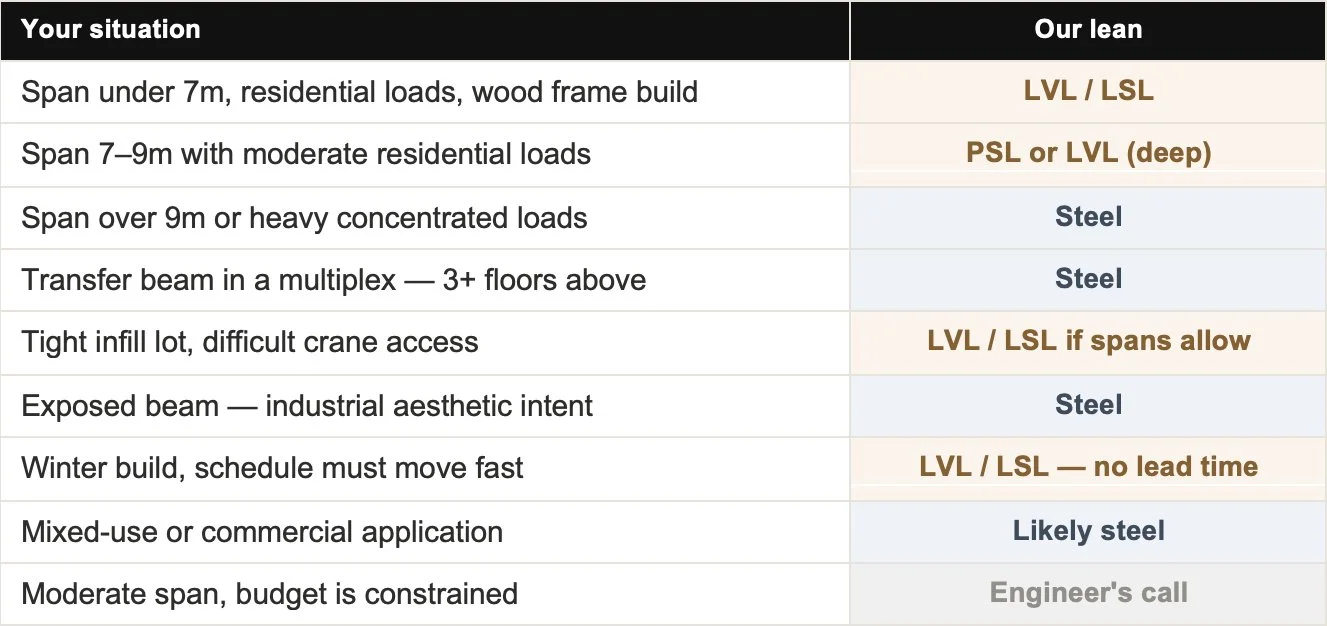
Quick Reference
How We Think About It on Our Builds
The framing contractor doesn't specify the beam material; that's the structural engineer's job, and rightly so. But we're the ones who have to coordinate the fabrication shop, book the crane, confirm the CWB welder's availability, and integrate the steel bearing into the surrounding wood frame. We have a front-row seat to what the beam choice actually costs in time and money.
Our honest read: engineered wood gets underestimated. LVL and PSL have gotten significantly stronger over the past decade, and the spans they can cover with a reasonable profile have expanded. For most custom home applications in the GTA — even large custom homes the load-bearing requirements land within what engineered wood handles well. The default to steel on residential projects is sometimes a habit rather than an engineering necessity.
At the same time, we've seen LVL forced into applications where the span and load genuinely demanded steel, and the result was a beam so deep it conflicted with the ductwork, the stair headroom, and the floor height all at once. When steel is the answer, the extra cost is worth it — and trying to avoid it with an oversized engineered wood section is often a false economy.
If you want our read on a specific application, we're happy to have that conversation.
Working through beam options for a build in Toronto or the GTA?
Whether you're deciding between steel and LVL, trying to understand what a specific steel beam installation will actually cost once you add crane and welder, or just want a framer's perspective on what your engineer has specified, we're happy to walk through it with you.
Call us at (647) 641-0550 or visit canastruct.ca/contact. No obligation — just a straight conversation from people who install both.