Why a 2×4 Isn’t 2 Inches by 4 Inches: The History of Lumber Standardization in Ontario

Why a 2×4 Isn’t 2 Inches by 4 Inches
Pick up a 2×4 stud at any lumber yard in Ontario and you're holding a piece of wood that is 1½ inches by 3½ inches. Not 2 by 4. Not even close. If you pulled a true 2×4 from a wall built before World War II, you'd feel the difference in your hands: more weight, more thickness, almost half again as much wood.
This isn't an accident, a conspiracy, or a modern cost-cutting trick. It's the result of over a century of industrialization, shipping economics, kiln technology, and negotiated standardization played out across North American lumber markets, codified by committees in the mid-20th century, and locked in by the time Canadian grading authorities formalized the rules we build by today.
As framers who work with this material every day, we think it's worth understanding. Not just the "what" of the dimensions, but the "why" behind how they got there and what the grade stamp on the side of every piece of structural lumber in Ontario actually tells you.
Before Standardization: Every Mill Ran Its Own Rules
Before roughly 1870, there was no such thing as a standard 2×4. If you needed lumber, you went to your local sawmill and told them what you wanted. The sawyer cut it roughly, with a pit saw or waterpower-driven sash saw, and you received a piece of wood that was approximately your requested dimension. Actual sizes varied by mill, by sawyer, by equipment quality, and by how green or dry the timber was when it was cut.
This wasn't a problem when the carpenter and the sawmill were in the same town. The problem arrived with the railroad. By the 1870s and 1880s, timber from the forests of Ontario, Quebec, and the northern United States was being shipped hundreds of kilometres. A carpenter in Toronto might be working with white pine from Georgian Bay one month and Douglas Fir from British Columbia the next. The "2-inch" stock from each source might actually measure anywhere from 1⅞ to 2⅛ inches.

Why a 2×4 Isn’t 2 Inches by 4 Inches
The lumberyard created the pressure for standardization
Retailers, not builders, drove the first push for consistent dimensions. When a yard was stocking lumber from multiple mills and multiple species, someone had to be able to compare cost and quality on a consistent basis. "2-inch stock" had to mean the same thing whether it came from Sudbury or New Westminster.
How the 2×4 Shrank: A Century of Incremental Change
The move from a true 2×4 to today's 1½×3½ didn't happen overnight. It was a gradual process shaped by technology, economics, and the physics of wood drying — each step small enough to be accepted at the time, cumulative enough to produce a dramatic difference over a century.
True rough-sawn dimensions: 2"×4" (Pre-1870)
Lumber cut to order at local mills. A "2×4" was a rough-sawn 2-inch by 4-inch piece of wood — green, unsurfaced, and delivered directly to the carpenter who would plane it on site. No national standard. No grading system. Every mill ran its own tolerances.
Industrial sawmilling and the railroad create chaos (1870s–1890s)
Steam-powered circular saws enable mass production. Lumber ships hundreds of kilometres. Species intermingle at market — Ontario white pine and BC Douglas Fir both labelled as "2×4" but measuring differently, behaving differently, drying differently. Lumberyards demand uniformity. Trade associations begin to form.
First American Lumber Congress calls for standardization (1919)
Post-WWI housing demand is surging. The US Department of Agriculture establishes the Forest Products Laboratory. After testing 75 mills, researchers conclude that studs of 1⅝" × 3⅝" are optimal — structurally sound and economically efficient. First real attempt at a national standard.
Planning becomes standard — dimensions shrink to ~1¾"×3¾" (1920s–1930s)
Mills begin drying and planing lumber before shipping rather than sending it green. This solves the moisture-variation problem but removes material. A true 2×4 cut green and planed smooth on four sides emerges from the process at roughly 1¾" × 3¾". Industry associations begin accepting these "dressed" dimensions as the working standard.
Post-WWII housing boom — kiln-drying standardizes at ~1⅝"×3⅝" (1940s–1950s)
Massive demand for post-war housing accelerates the shift to kiln-dried, pre-surfaced lumber. Kiln drying removes moisture in a controlled environment before planing — the planed piece is already at its final dried dimension. The industry broadly adopts 1⅝" × 3⅝" across North America, though regional variations persist.
The Scottsdale Agreement: modern dimensions locked in at 1½"×3½" (1961)
At a landmark committee meeting in Scottsdale, Arizona, the Committee on Grade Simplification and Standardization formally fixes the dressed size of 2-inch nominal lumber at 1½ inches. The nominal 4-inch width becomes 3½ inches. This is the standard that applies to every 2×4 stud sold in Ontario today. The reasoning: it simplifies math, had already become the practical norm in many areas, and engineering design tables were calibrated to these dimensions.
Canada: NLGA standardizes grading rules and grade stamps (Since 1960)
The National Lumber Grades Authority (NLGA), based in Surrey, BC, establishes and maintains Canada's standard grading rules for structural lumber. Since 1960, virtually all lumber produced in Canada has been marked with a standardized grade stamp. NLGA rules are approved by both the Canadian Lumber Standards Accreditation Board (CLSAB) and the American Lumber Standard Committee (ALSC), enabling Canadian SPF to be used under both Canadian and American building codes.
The nominal system is permanent — and for good reason (Today)
Modern sawmills could cut true 2×4 lumber precisely. But every building code table, engineering design value, joist span table, and framing standard in Ontario is calibrated to the actual dimensions. Changing the nominal name would require rewriting every code publication and retooling the mental model of every framer, inspector, and architect on the continent. So the name stays, and framers work with actual dimensions.

Why the shrinkage happened: the three forces that drove it
It's easy to assume the lumber industry simply got away with selling less wood. The reality is more complicated — three separate forces each pushed dimensions down, independently and cumulatively.
Drying & Shrinkage
Green lumber contains up to 50%+ moisture by weight. When kiln-dried, wood shrinks approximately ¼–⅜ inch per face. This was unavoidable once pre-drying became standard — you cannot dry a 2-inch board and end up with a 2-inch board.
Planing / Surfacing (S4S)
Consumers and builders wanted smooth, ready-to-use lumber with surfaced four sides. Planing removes an additional ⅛–¼ inch per face. Combined with drying shrinkage, a 2-inch board is now roughly 1½ inches. Accuracy improved, but size decreased.
Shipping Economics
Freight charges in the early 20th century were calculated by weight and distance. Thinner, lighter lumber costs less to ship over the long distances from BC, Ontario, and Quebec to urban markets. Industry associations had a direct financial incentive to accept smaller dress sizes.
The structural argument for smaller:
Research in the 1920s found that reducing a 2×4 from its full rough-sawn size to a dressed size didn't meaningfully compromise its structural performance in stud-wall applications. The material removed in planing is mostly surface material — drier, more variable, and contributing less to the core strength. The remaining piece is actually more uniform and structurally consistent than the original rough-sawn green board.
The Complete Nominal vs. Actual Dimensions Chart
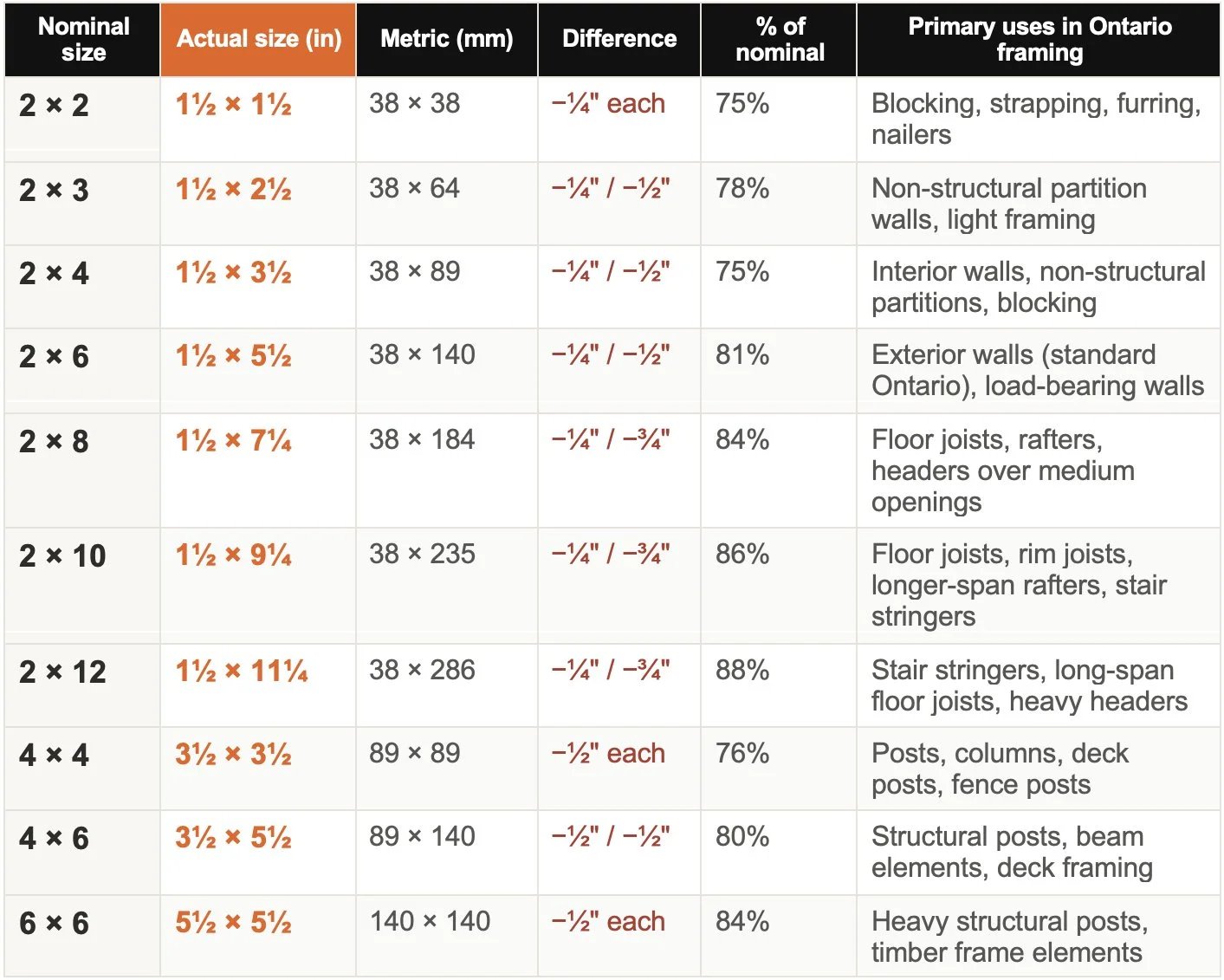
Here are the standard dressed dimensions for dimensional lumber sold and used in Ontario today. Always design, cut, and calculate to actual dimensions — not nominal ones. The nominal name is only a label.
Notice the pattern in the width dimension
2× and 4× lumber up to 6 inches wide loses ½ inch. From 8 inches and up, the actual width is ¾ inch under nominal. This is why a 2×8 is 7¼ inches, not 7½ — wider boards contain more moisture and shrink more during kiln drying, so more material is removed in the surfacing process.
What "Construction Grade SPF" Actually Means
Walk into any lumber yard in Ontario and you'll see bundles of framing lumber stamped with codes most homeowners have never had explained to them. "S-P-F No. 2 & Btr S-Dry NLGA." That stamp is a complete specification — species, grade, moisture content, and the authority that certified it.
SPF: the dominant species group in Ontario residential framing
SPF stands for Spruce-Pine-Fir — not a single species, but a species group that includes black spruce, white spruce, red spruce, jack pine, lodgepole pine, balsam fir, and alpine fir. These species grow together across Canadian forests, are harvested together, and have sufficiently similar structural properties to be graded, certified, and specified together as a single engineering unit.
The advantages of SPF for residential framing are well established: trees grow in Canada's northern climate, naturally producing tight, small knots and straight grain. The wood is light, easily workable, accepts nails and screws cleanly, and has a strength-to-weight ratio well suited to platform-frame construction. It grows abundantly in Ontario, Quebec, and British Columbia — which is why it dominates the supply chain for every framing lumber yard in the province.

The Canadian species groups you'll encounter
D.Fir-L (Douglas Fir-Larch, common from BC) is heavier and stiffer than SPF — specified by engineers for applications requiring higher stiffness, like long-span floor joists. Hem-Fir is another BC group used structurally. In Ontario framing, SPF is the overwhelming default, and engineering design values in the OBC span tables are calibrated to SPF.
The grade system: from Select Structural to Economy
Every piece of structural lumber produced in Canada is visually inspected by a trained lumber grader and assigned a grade based on the characteristics of that specific piece. The grade reflects the presence and severity of natural wood features — knots, wane, slope of grain, shakes, splits, and checks — that correlate with structural strength and stiffness.
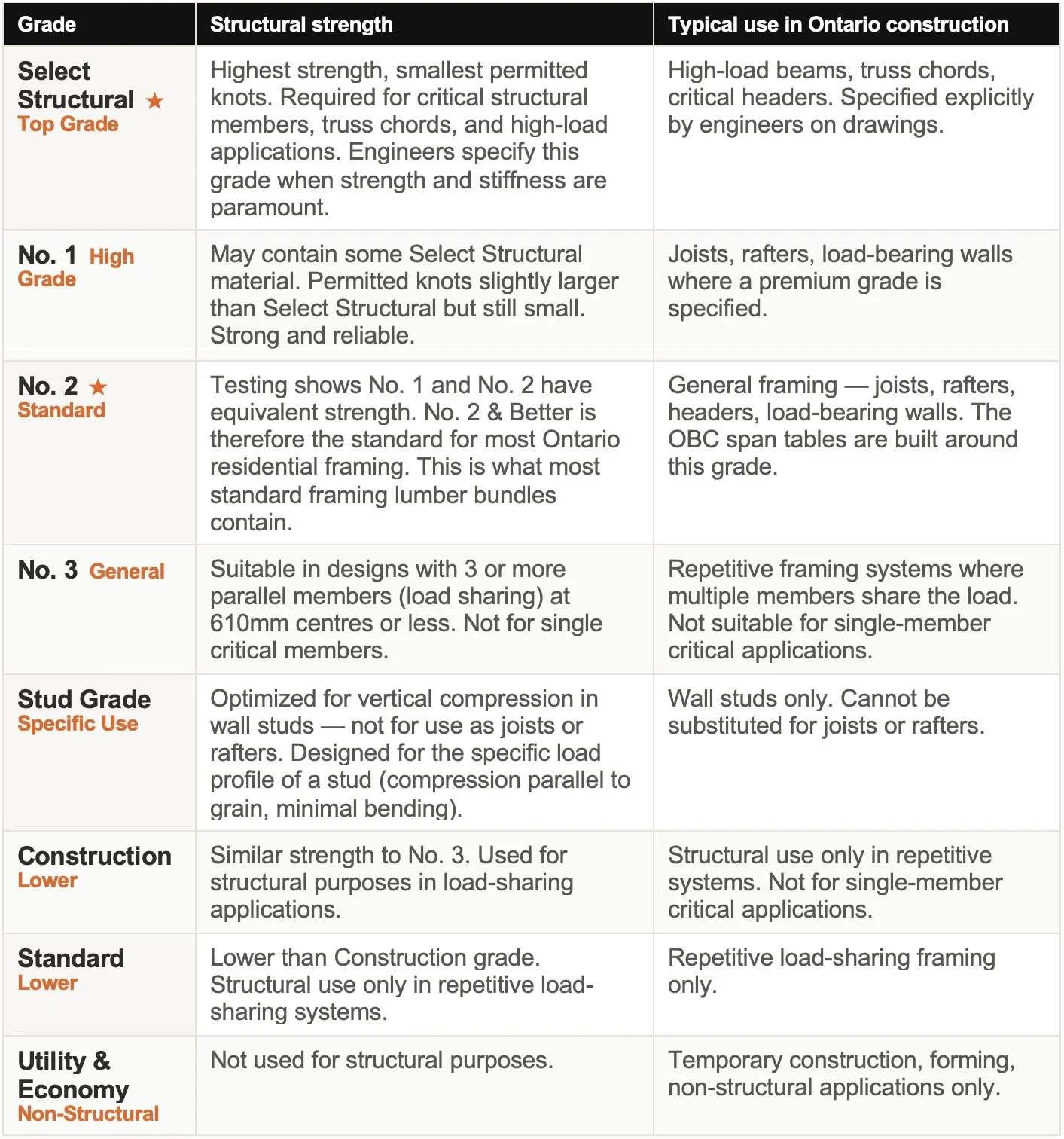
The practical upshot for most Ontario residential framing: you're buying SPF No. 2 & Better kiln-dried to ≤19% moisture content (S-Dry or KD-19). This is what the OBC span tables are built around. When an engineer specifies a higher grade for a specific member — a long-span floor joist carrying heavy loads, a truss chord, a critical header — they'll say so explicitly on their drawings.
Reading the Grade Stamp: What Every Mark Means
Every piece of structural lumber sold in Canada carries a grade stamp placed approximately 18 inches (45 cm) from one end. The stamp is your complete specification sheet — species, grade, moisture content, mill of origin, and the grading authority. Here's how to decode it.
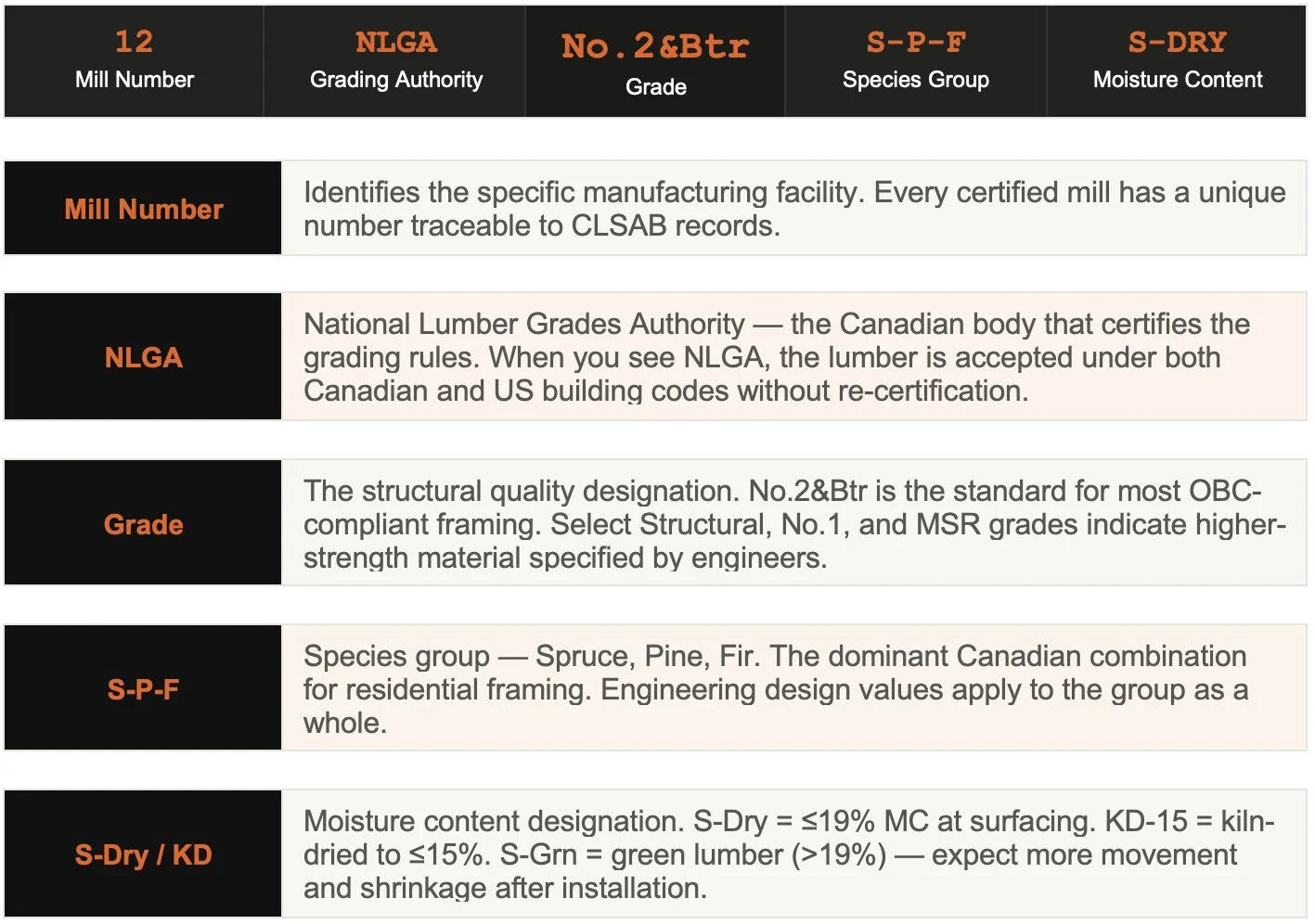
The grade stamp is what your framing inspector is looking for. In Ontario, under the OBC, every piece of structural lumber used in a permitted residential build must be grade-stamped by a CLSAB-accredited agency. Unstamped lumber — even if it's perfectly good wood — cannot be used in structural applications without a separate grading inspection and certification by an accredited agency.
Why This Matters on a Real Job Site in Toronto
Understanding nominal versus actual dimensions isn't just trivia. It has direct implications for every framing calculation on site.
Wall thickness: A 2×6 exterior wall — the standard for Ontario energy code compliance — is not 6 inches thick. The framed wall is 5½ inches of lumber. Architects and structural engineers use the actual 5½-inch dimension for rough opening calculations and load calculations. Use the nominal 6 and your windows won't fit.
Stud layout: The 16-inch on-centre stud spacing that governs most Ontario residential framing is derived from and engineered around the actual stud width of 1½ inches. The structural engineering tables that tell you what loads a 2×4 stud wall at 16 o.c. can carry are calibrated to the 1½-inch actual dimension.
Span tables: The OBC span tables for joists and rafters are all calibrated to actual dimensions. A 2×10 floor joist is engineered as a 1½ × 9¼ inch member. If you try to back-calculate a span table using nominal dimensions, you'll get a different answer than the table gives you. The table is right. Use actual.
The name is historical. The dimension is engineering.
Nobody in the framing trade thinks a 2×4 is actually 2 inches thick. But the confusion surfaces constantly with homeowners, architects who haven't detailed a wood-frame project recently, and anyone calculating rough-opening sizes from a plan set. Call it a 2×4. Draw it as 1½ × 3½. The OBC doesn't care what you call it. It cares what you build.

Questions about framing materials for your Toronto or GTA build?
Whether you're planning a custom home, a fourplex, or a basement suite and want to understand what grade of lumber your project actually needs or just want a straight read on materials before you talk to suppliers — we're happy to have that conversation.
Call us at (647) 641-0550 or visit canastruct.ca/contact. No sales pitch — just a practical conversation from people who frame with this material every day.